 Accueil
 Appareil: B43A-459B-724C
 Vol ID: 1334
Afficher événements
Télécharger
Ajuster temp. & pression ?
Image
Jeux de données
Cliquez sur la légende pour afficher ou masquer les données
Zoom
Cliquez-glissez ou pincez sur mobile
Comparer un vol ?
Résumé du vol
Altitude
Apogée
161.24 Mètres
Temps jusqu’apogée
6.19 seconds
Altitude fin combustion
62.59 m
Altitude vitesse max.
45.97 m
Altitude éjection
160.26 m
Altitude atterrissage
0.33 m
Stabilité
Score de stabilité
40.5 / 100 (Correct)
Détail de stabilité
Inclinaison à la fin de combustion (20%)67.5
Constance d’inclinaison (15%)82.2
Tangage/lacet (30%)0
Amortissement (20%)0
Rectitude de poussée (15%)98.1
Vitesse
Max. montée
53.32 m/s
Max. descente
-16.94 m/s
À fin combustion
43.840 m/s
Vitesse atterrissage
-12.112 m/s
Vitesse descente
-11.276 m/s
Vitesse éjection
0.03 m/s
Recovery
Single deploy (no dual deploy detected)
Accélération
Max. montée
8.35 G
Max. descente
9.41 G
Max. pendant combustion
8.35 G
Moy. montée
0 G
Moy. combustion
3.31 G
Temps
Fin combustion (premier)
1.63 seconds
Apogée
6.19 seconds
Éjection possible
6.671 seconds
Atterrissage
20.5 seconds
Sortie #1 ON
0 seconds
Sortie #1 OFF
0 seconds
Angles
Inclinaison rampe
1.83°
Incl. max. jusqu’à fin comb.
9.60°
Roulis au lancement
-1.83°
Tangage au lancement
-1.43°
Rotation max. (comb.)
764.96 dps
Rotation moy. (comb.)
72.88 dps
Général
Date envoi
21-Mar at 10:49
Échantillons
1725
Durée totale enregistrement
33.800 s
Moy. échantillons/s
51
Nombre de verrouillages
0
Altitude enregistrement
338.56 m
Lancement après démarrage
6m 34s
Axe de référence
X
Batterie & température
Batterie début
85%
Batterie fin
84%
Température début
29.54°C
Température fin
28.86°C
Temp. MT1 lancement
0°C
Règles de sortie
Aucune règle configurée
Animation des données
FLIGHT 1334
161.24 Meters
ALTITUDE
0.00m
VELOCITY
0.00m/s
ACCEL
0.00G
TILT
0.00°
PITCH
0.00°
ROLL
0.00°
YAW
0.00°
TIME
0.00s
AWAITING LAUNCH
ALT
altimetercloud.com
LAUNCH
T+0.00s
LANDING
BURNOUT
Motor burn complete
Note : L’animation de vol nécessite que votre altimètre soit monté dans une orientation fixe. Calibrez vos capteurs pour de meilleurs résultats.
Notes utilisateur
Ajoutez cet appareil à votre compte pour modifier
Vidéo Youtube
Aucune vidéo
Ajoutez cet appareil à votre compte pour modifier
Images du vol (0)
Aucune image
Fusée associée
Aucune fusée associée à ce vol
Informations appareil
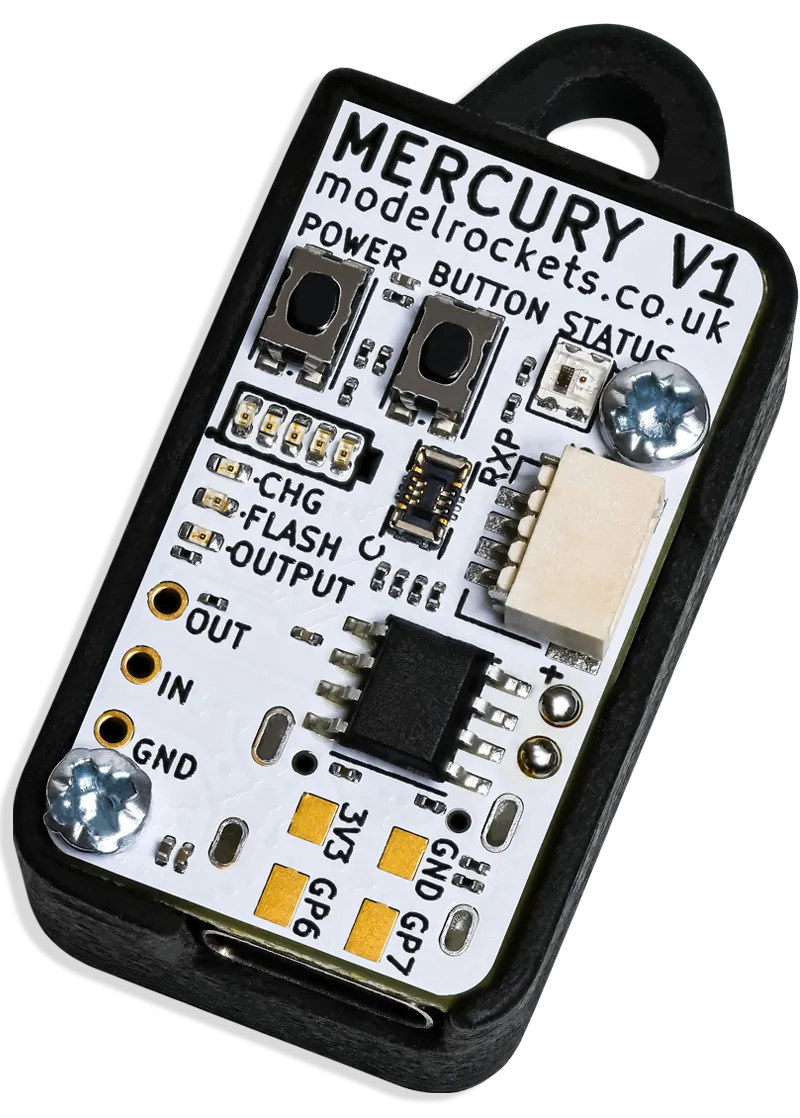
Mercury V1
Ce vol a été effectué sur un Mercury V1.
Version matériel
Rev 2
Version logiciel
2.21
Dernière connexion
21-Mar at 11:05
Accéléromètre
32G 3-axis
Gyroscope
2000 dgps 3-axis
Capteur pression
Bosch BMP 390
Magnétomètre
N/A
Moteurs du vol
1st Stage
1x
Klima
C6-5
Durée combustion
1.60 seconds
Diameter
18.00 mm
Poussée moyenne
6.00 N
Poussée max.
15.00 N
Impulsion
10.00 Ns
Classe impulsion
C
Poids total
20.50 g
Poids propergol
9.60 g
Type propergol
composite
Liens
Ajoutez cet appareil à votre compte pour modifier
Site de lancement, date & heure
Cliquez sur la carte pour marquer votre site de lancement. Basculez entre vue carte et satellite.
No results found — try a different search.
Cliquez sur la carte · Glissez pour ajuster
Lat—
Lng—
✓ Launch location saved successfully.
✗ Could not save location — please try again.
Règles de sortie
Les règles permettent au Mercury d’effectuer des actions selon les conditions de vol. Chaque règle a jusqu’à 4 conditions (A-D).
Aucune règle configurée
Correspondance moteur (BETA)
Encore en phase de test ! Nous cherchons à deviner quel moteur a été utilisé.
Marque
Moteur
Score
Forme
Comb.
Estes
E16
121
92.8%
94.9%
TSP
D12~2
73
89.7%
91.5%
Loki
J396-SP
56
29.9%
85.3%
AeroTech
F37
48
71.8%
89.3%
Klima
C6
46
78.1%
82.3%
AeroTech
E24C
43
66%
83.5%
AeroTech
G67R
41
77.3%
88.9%
AeroTech
I305FJ
40
25.5%
78.8%
AeroTech
F32
38
74.5%
84.5%
AeroTech
I215R
38
71.7%
86.4%
Comparaison de vol
Comparing against 11 other flights with the same motor configuration.
Highest apogee
The maximum altitude reached. Higher is better for altitude-focused flights.
161.24m|199.39 best2nd
Best stability
Composite score from tilt, spin rate, and ascent efficiency. 100 is perfect.
40.5/100|82.5 best8th
Fastest velocity
Peak ascent velocity recorded during the flight.
53.32m/s|61.1 best2nd
Best avg burn G
Average acceleration during motor burn, in G-force.
3.31G|3.56 best2nd
Longest flight
Total recording duration from launch to landing detection.
33.79s|52.3 best5th
Lowest spin
Average spin rate during burn. Lower means a straighter flight.
72.88dps|53.82 best5th
Coldest flight
Board temperature at launch. Cold conditions affect battery and sensors.
29.54C|0.16 best9th
Combustion moteur
Ceci est la magnitude de sortie de l’accéléromètre du lancement à la fin de combustion.
You can check this against your motors thrust data on thrustcurve.org.
Paramètres généraux
Ceci est un aperçu des paramètres utilisés pour ce vol. Rendez-vous sur la
Rendez-vous sur la page Mes appareils puis Configurer les paramètres..
Pression prévue
i
Set this to your local forecast pressure at sea level. This will offer you slightly improved accuracty for your flight, although it's not 100% essential every little helps!
Xcweather.co.uk is a decent place to grab pressures from for your location and time.
Xcweather.co.uk is a decent place to grab pressures from for your location and time.
1013.2 mbar
Détection lancement
i
This is the altitude above the launch pad altitude where the altimeter will trigger itself into recording / flight mode.
The altimeter keeps a constant average of the pressure while waiting for launch, it uses a simple algorithm and the pre-flight buffers to do this. The most recent 120 samples (~4 seconds) are ignored so your pre-trigger altitude won't effect the ground baseline.
For almost all uses we suggest keeping this on the 25 Meter (~82 feet) default settings. If you want to test your altimeter by throwing it in the air, or are planning a very low flight you may want to lower the setting.
The altimeter keeps a constant average of the pressure while waiting for launch, it uses a simple algorithm and the pre-flight buffers to do this. The most recent 120 samples (~4 seconds) are ignored so your pre-trigger altitude won't effect the ground baseline.
For almost all uses we suggest keeping this on the 25 Meter (~82 feet) default settings. If you want to test your altimeter by throwing it in the air, or are planning a very low flight you may want to lower the setting.
10
meters
Ratio échantillonnage
i
The altimeter runs at 50Hz however you can record every sample or every X samples in order to extend the log time. For example if you set the ratio to 1 it will save 1:1 samples, or if you set it to 3 it will save 1 in 3 samples.
1:1 (50Hz)
Max. échantillons
i
This is the maximum samples the altimeter will log per flight. When it reaches this amount it will stop and save the recording.
12000
Arrêt enregistrement
i
This setting is how the altimeter decides to stop recording. You can choose either 300 or 600 samples stable or it will record until it's 10000 sample limit unless you press the BUTTON in Manual stop mode.
The samples stable method waits for the devices altitude not to change for the set number of samples. This is defined by not changing by more than +/- 1.0 meters for 98% of the samples, it's a reliable method to stop the recording after landing within 8-10 seconds (300 sample) or 16-20 seconds (600 sample).
The samples stable method waits for the devices altitude not to change for the set number of samples. This is defined by not changing by more than +/- 1.0 meters for 98% of the samples, it's a reliable method to stop the recording after landing within 8-10 seconds (300 sample) or 16-20 seconds (600 sample).
Auto: 300 samples stable
Suréchantillonnage
i
Oversampling is a internal setting of the BMP 390 pressure sensor. It is how many samples are taken for each reading. By taking multiple samples for each pressure reading the altimeter reduces noise and increases the resolution of the output.
The sensor can run at 50 samples per second in 4X mode, so we suggest leaving it in this mode as it will offer the highest accuracy.
The sensor can run at 50 samples per second in 4X mode, so we suggest leaving it in this mode as it will offer the highest accuracy.
8x Oversampling
Filtre IIR
i
The IIR filter is another internal sensor for the BMP390 pressure sensor. It is a Infinite impulse response filter used to enhance pressure measurement accuracy by reducing noise. It's primarily for smoothing out rapid pressure changes.
We suggest not setting this too high as it will cause delay to changes in altitude if set very high.
We suggest not setting this too high as it will cause delay to changes in altitude if set very high.
COEFF 7
Filtre pression
i
This filter is a software Kalman filter that runs on the altimeters processor.
The Kalman filter uses a prediction step based on a system model and then a correction step using new measurements to refine its estimate, it creates accurate most certain results from data with noise in it.
The Kalman filter uses a prediction step based on a system model and then a correction step using new measurements to refine its estimate, it creates accurate most certain results from data with noise in it.
Kalman 2 (default)
Temps verrouillage
i
The Lockout time is how long the altimeter should stop making decisions and taking actions if it detects unusual high speed altitude changes that are unexpected.
These false readings can be caused by ejection charges (if the altimeter is in the same compartment as the motor ejection gases) or even when you transition to Mach speeds and can give false readings of altitude changes.
When these events are detected the system enters Lockout for the specified time while it stabalises. This effects things like triggering the output, or calculating other data.
These false readings can be caused by ejection charges (if the altimeter is in the same compartment as the motor ejection gases) or even when you transition to Mach speeds and can give false readings of altitude changes.
When these events are detected the system enters Lockout for the specified time while it stabalises. This effects things like triggering the output, or calculating other data.
750ms
Changement verrouillage
i
This is how we detect a lockout. If the pressure changes by this much in a single sample downwards (pressure increase, lower altitude) then it's likely to be a false reading. Multiply the setting by 32 to get the speed in meters per second that it will trigger at.
1.5 meters
Synchro capteurs
i
The filters on the pressure sensor can cause it to lag very slightly behind the Accelerometer and Gyroscope data.
The Sync sensors option detects how far out of sync these sensors are. It then corrects the Acceleration and Gyroscope readings to match the pressure sensor.
ACTIVÉ (18 samples / 354.00ms)
Orientation
i
This is the orientation you intend to install the Altimeter in your rocket. It's needed to ensure completly accurate angles and orientation charts and reports. Check out the Manual for more information on this.
Upwards (text up)
Filtre IMU
i
The IMU filter, or fusion filter takes the data from each axis of the Gyroscope and Accelerometer to calculate the Pitch, Roll, Yaw and tilt angle from vertical.
These filters can build up some discrepency over time so it's important to calibrate your sensors to minimise this.
Madgwick 6-Axis
ALP lancement
i
This is prevention against accidental launch detection.
With this disabled the launch is based only on pressure and something that creates a low pressure can trigger the flight by accident. For example pulling your nose cone off can even trigger it.
With this enabled the rocket also needs to have seen 8 samples (0.25 seconds) of acceleration above this setting in the last 3 seconds as well as the pressure drop to trigger. There is a backup trigger of 1.05 seconds of altitude being above the launch detect setting too.
There are very few situations where this option would cause issues, so we suggest leaving it on.
With this disabled the launch is based only on pressure and something that creates a low pressure can trigger the flight by accident. For example pulling your nose cone off can even trigger it.
With this enabled the rocket also needs to have seen 8 samples (0.25 seconds) of acceleration above this setting in the last 3 seconds as well as the pressure drop to trigger. There is a backup trigger of 1.05 seconds of altitude being above the launch detect setting too.
There are very few situations where this option would cause issues, so we suggest leaving it on.
1.4G
Verrouillage lancement
i
When enabled, the altimeter locks out recording for a set period after power on to prevent false triggering during setup.
DISABLED
Température statique
i
A fixed temperature value used for altitude calculation when the external temperature sensor is disabled or not connected.
15.00 °C
Capteur temp.
i
If an external MT1 temperature sensor is connected, this controls whether it is used for logging only or also for altitude calculations.
DISABLED
Paramètres de sortie
Ceci est un aperçu des paramètres utilisés pour ce vol.
Sortie 1 activée
i
Disable or enable the output from being able to turn on or off.
DÉSACTIVÉ
Sortie 1 déclencheur
i
After apogee (altitude)
This method triggers when the altitude drops below the set altitude after apogee is detected.After apogee (time)
This method triggers the defined seconds after apogee is detected.After launch (altitude)
This method is activated if/once the altimeter exceeds the set altitude after launch.After launch (time)
This option triggers the defined seconds after launch is detected.After burnout (time)
This method triggers the defined seconds after burnout is detected.
After apogee (altitude)
Sortie 1 durée
i
This is how long the output should trigger ON state when the rules are met.
2000ms
Sortie 1 altitude
i
This is the altitude to trigger at if using a trigger method that works on altitude.
For example if you set this to 75m and After apogee (altitude) for the trigger then the output will turn on at 75m on descent above the launch altitude.
For example if you set this to 75m and After apogee (altitude) for the trigger then the output will turn on at 75m on descent above the launch altitude.
0 meters
Sortie 1 temps
i
This is the time variable for output triggers that work on time.
For example if you set this to 3 seconds and After apogee (time) as the trigger then the output will turn on 3 seconds after apogee.
For example if you set this to 3 seconds and After apogee (time) as the trigger then the output will turn on 3 seconds after apogee.
0 seconds
Verrouillage altitude
i
Altitude lock is a safety feature that prevents the output from triggering if the altitude is below this level when the rules are met.
50.00 m
Verrouillage inclinaison
i
This is another safety feature. It can be used to disable the output if the rocket has gone too far from vertical.
For example if you set the tilt angle lock to 40 degrees then the output will not fire if the rocket is more than 40 degrees from vertical. To disable set this to 0.
For example if you set the tilt angle lock to 40 degrees then the output will not fire if the rocket is more than 40 degrees from vertical. To disable set this to 0.
0.00 °
Étalonnage capteurs
Décalages de calibration utilisés pour ce vol.
Gyroscope
X
-0.410°
Y
-1.040°
Z
0.350°
Accéléromètre
X
-8.550 mG
Y
24.720 mG
Z
20.110 mG
Paramètres appareil
Ceci est un aperçu des paramètres utilisés pour ce vol.
Ceci est un aperçu des paramètres utilisés pour ce vol.
TAG appareil
i
A custom name or tag assigned to this device for easy identification.
Merc7408
Langue
i
The language setting configured on the device.
en
Mode arrêt
i
Controls what happens after recording. Standard shuts down normally, Delayed keeps WiFi on for 30 seconds after landing, Stay on keeps the device powered on.
Delayed 30s
Luminosité LED
i
The brightness level of the LED indicators on the Mercury. Lower values save battery.
20%
Puissance WiFi TX
i
WiFi transmit power level. Higher gives better range but uses more battery.
5 dBm (default)
Mode veille
i
Controls whether the device enters low-power sleep when idle.
Normal (sleep when idle)
Surveillance batterie
i
Monitors battery voltage during the flight.
DISABLED
Groupe cloud
i
The cloud group / category this flight is assigned to.
1
Ports GP6 / GP7
Configuration des ports GP6 et GP7 pour canaux pyro, servos ou autres appareils.
Mode canal 6
ON = HIGH
Ch6 min pulse (µs)
1000
Ch6 max pulse (µs)
2000
Ch6 frequency
50 Hz
Ch6 angle ON
170.00°
Ch6 angle OFF
10.00°
Ch6 on time
2.00s
Mode canal 7
ON = HIGH
Ch7 min pulse (µs)
1000
Ch7 max pulse (µs)
2000
Ch7 frequency
50 Hz
Ch7 angle ON
170.00°
Ch7 angle OFF
10.00°
Ch7 on time
2.00s
Carte servo I2C PCA9685
Ceci est un aperçu des paramètres utilisés pour ce vol.
Configuration de la carte servo externe I2C PCA9685 avec jusqu’à 6 canaux servo supplémentaires.
Aucune carte servo I2C n’était connectée pour ce vol.
Prédiction et aérofreins
Ceci est un aperçu des paramètres utilisés pour ce vol.
Le Mercury peut prédire l’apogée pendant la phase de vol libre. Ces paramètres contrôlent le calcul et le système d’aérofrein.
Masse sèche
i
The total mass of the rocket after motor burnout (dry mass). This is used for the ballistic prediction of apogee altitude. Enter the mass without the motor propellant, or the mass at burnout.
0.1500 kg
Coefficient Cx
i
The aerodynamic drag coefficient (Cd) of the rocket. This is used with the rocket area to calculate aerodynamic drag during coast. A typical model rocket has a Cd of 0.4 to 0.8. You can find this value from OpenRocket or RockSim simulations.
0.750
Surface référence
i
The cross-sectional reference area of the rocket in square meters. This is typically the area of a circle with the body tube diameter. For example a 38mm tube has an area of approximately 0.00113 m².
0.00100 m²
Gas constant
i
The specific gas constant for dry air, used in the atmospheric model for altitude and density calculations. The standard value is 287.05 J/(kg·K). You shouldn't need to change this unless you know what you're doing.
287.05 J/(kg·K)
Les paramètres suivants configurent le système d’aérofrein.
Aérofrein activé
i
Enables or disables the active air braking system. When enabled, the Mercury will deploy air brakes via the configured servo channel to try and reach the target altitude. Firmware 2.1+ required.
OFF (default)
Servo channel
i
Which servo output channel the air brake mechanism is connected to. GP6 and GP7 are the two onboard servo headers, I2C channels are for an external servo expander board.
GP6
Deploy speed
i
The speed at which the air brakes deploy. The Mercury gradually increases the servo angle until the predicted apogee matches the target rather than going full on/off. This setting controls how quickly it ramps up to full braking.
Medium (default)
Altitude cible
i
The target apogee altitude in meters. The air brake system will try to slow the rocket so it reaches this altitude.
300.00 m
Over shoot %
i
The percentage over the target altitude to aim for until within 15% of the target. This helps prevent undershooting if the prediction is slightly off early in the coast. For example, with a 1000m target and 5% early adjustment, the Mercury will aim for 1050m until it passes 850m.
5.00%
Activation altitude
i
The air brake system activates after burnout, but won't engage until the rocket has reached this percentage of the target altitude. This prevents the brakes from deploying too early when predictions may be less accurate.
20% (default)
Commentaires
Commentaires
Connectez-vous pour commenter.
Connectez-vous pour commenter.