Distância
Escolha a unidade de distância: Metros(m), Pés(ft), Milhas(mi) ou Quilômetros(km)
Velocidade
Escolha a unidade de velocidade: m/s, ft/s, mph ou km/h
Aceleração
Escolha a unidade de aceleração: m/s² ou G
Flight 1847
Mostrar eventos
Apogeu Fim combustão Aterragem Saída/Regras Bloqueios Velocidades Ejeção
Transferir
Ajustar temp. & pressão ?
Imagem
Zoom
Clique e arraste, ou belisque no telemóvel
Comparar voo ?
Resumo do voo
Altitude
Apogeu
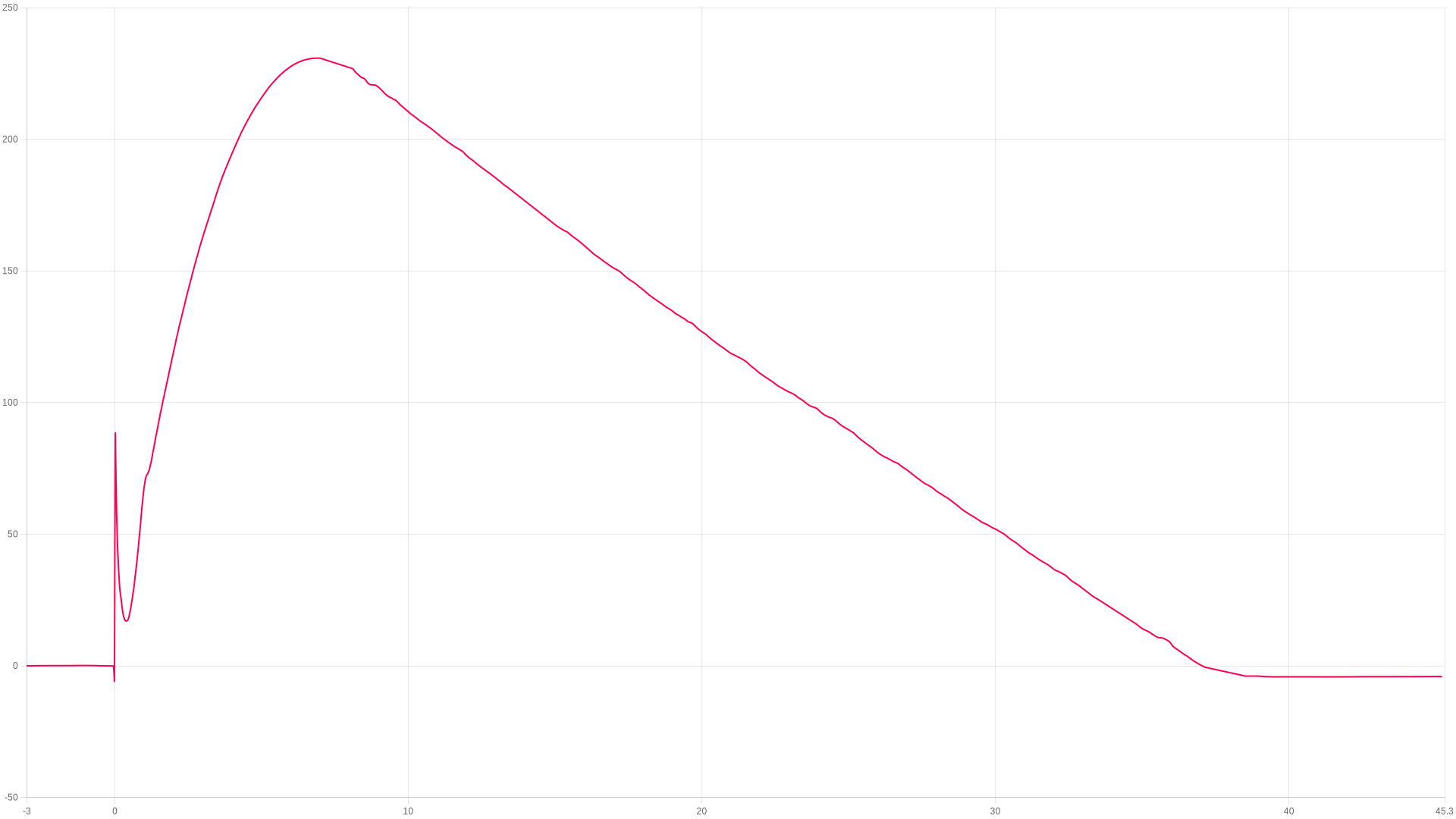
230.86 Metros
Tempo até apogeu
6.94 seconds
Altitude fim combustão
215.68 m
Altitude vel. máx.
-0.01 m
Altitude ejeção
229.88 m
Altitude aterragem
-2.37 m
Estabilidade
Pontuação estabilidade
5.2 / 100   (Fraco)
Inclinação no fim da queima (20%)0
Taxa arfagem/guinada (30%)9.1
Coning · boost (25%)11.9
Retidão de empuxo (15%)0
Launch tilt 50° · Coning 314.5/271.3°/s · Spin 312.2°/s · Thrust 50.6%
About this score
Worked out from the flight log between liftoff and 80% of apogee, independent of the angle the altimeter was mounted at in the airframe.
Inclinação no fim da queima (20%) – how close to vertical it left the rod.
Taxa arfagem/guinada (30%) and Coning · boost (25%) – how much the nose swung off the rocket's own axis. The main factor.
Retidão de empuxo (15%) – how cleanly the motor pushed along the body.
Spin about the rocket's own axis is not counted against it — a fast, straight spin is stable. The line under the bars shows the raw measurements.
Velocidade
Máx. subida
116.19 m/s
Máx. descida
-280.8 m/s
No fim combustão
16.270 m/s
Vel. aterragem
-6.476 m/s
Vel. descida
-7.294 m/s
Vel. ejeção
-3.60 m/s
Recovery
Single deploy (no dual deploy detected)
Aceleração
Máx. subida
18.84 G
Máx. descida
4.13 G
Máx. durante combustão
18.84 G
Média subida
0.87 G
Média combustão
1.58 G
Tempos
Fim combustão (primeiro)
4.99 seconds
Apogeu
6.94 seconds
Possível ejeção
7.265 seconds
Aterragem
37.89 seconds
Saída #1 ON
0 seconds
Saída #1 OFF
0 seconds
Ângulos
Inclinação rampa
66.55°
Thrust calc pad tilt
50°
Incl. máx. até fim comb.
81.19°
Rolagem no lançamento
48.22°
Arfagem no lançamento
-53.32°
Rotação máx. (comb.)
2760.47 dps
Rotação média (comb.)
366.58 dps
Geral
Flight time (approx)
Data envio
25-Jun at 10:46
Amostras de dados
7458
Tempo total gravação
63.400 s
Média amostras/s
117.6
Número de bloqueios
3
Altitude gravação
71.89 m
Lançamento após arranque
23m 24s
Eixo de referência
Z
Bateria & temperatura
Bateria início
76%
Bateria fim
74%
Temperatura início
33.26°C
Temperatura fim
33.23°C
Temp. MT1 lançamento
0°C
Regras de saída
Sem regras configuradas
Animação dos dados

FLIGHT 1847

230.86 Meters

ALTITUDE
0.00m
VELOCITY
0.00m/s
ACCEL
0.00G
TILT
0.00°
PITCH
0.00°
ROLL
0.00°
YAW
0.00°
TIME
0.00s
AWAITING LAUNCH
ALT
altimetercloud.com
LAUNCH T+0.00s LANDING

BURNOUT

Motor burn complete

Nota: A animação de voo requer que o altímetro esteja montado numa orientação fixa. Calibre os sensores para melhores resultados.
Notas do utilizador
Adicione este dispositivo à sua conta para editar
Vídeo Youtube
Sem vídeo
Adicione este dispositivo à sua conta para editar
Imagens do voo (0)
Sem imagens
Foguete associado
Nenhum foguete associado a este voo
Informações do dispositivo
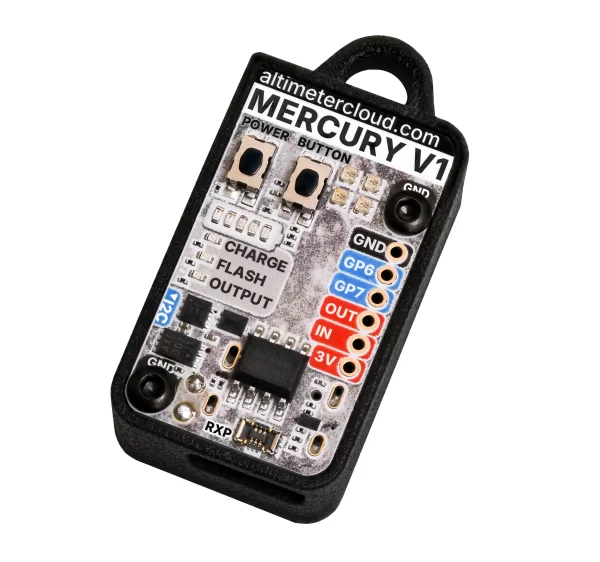
Mercury V1
Revision 3
Mercury V1
Este voo foi realizado num Mercury V1.
Versão hardware
Rev 3
Versão software
2.40
Última ligação
25-Jun at 10:46
Acelerómetro
32G 3-axis
Giroscópio
2000 dgps 3-axis
Sensor pressão
Bosch BMP 581
Magnetómetro
N/A
Motores do voo
Nenhum motor adicionado a este voo
Adicione este dispositivo à sua conta para editar
Combustão do motor
To overlay a thrustcurve here, add your motors to this flight using the “Flight motors” box above. The combined thrust curve is then scaled to match the recorded acceleration peak.
Local de lançamento, data e hora

Clique no mapa para marcar o local de lançamento. Alterne entre vista de mapa e satélite.

Clique no mapa · Arraste para ajustar

Lat Lng
✓ Launch location saved successfully.
✗ Could not save location — please try again.
Rule events
No output rules fired during this flight.
Correspondência motor (BETA)
Ainda em modo de teste! Estamos a descobrir qual motor foi usado no voo.
Marca
Motor
Pontuação
Forma
Comb.
Contrail
G300
48
87.4%
77.4%
Estes
1/4A3T
22
-3.1%
52.4%
Estes
1/2A3T
0
60.1%
56.4%
Estes
1/2A6
0
-22.2%
49.8%
Cesaroni
25-E75-VM-17A
0
49.7%
69.2%
Cesaroni
68-F240-VM-15A
0
45.6%
66.3%
AeroTech
G339N
0
53.3%
71.4%
AeroTech
H669N
0
73.6%
62.3%
AeroTech
I1299N
0
42.8%
61.9%
Definições gerais do voo
Este é um registo das definições utilizadas para este voo. Visite a Visite a página Meus dispositivos e configure as definições..
Pressão prevista
i
Set this to your local forecast pressure at sea level. This will offer you slightly improved accuracty for your flight, although it's not 100% essential every little helps!

Xcweather.co.uk is a decent place to grab pressures from for your location and time.
1013.2 mbar
Deteção lançamento
i
This is the altitude above the launch pad altitude where the altimeter will trigger itself into recording / flight mode.

The altimeter keeps a constant average of the pressure while waiting for launch, it uses a simple algorithm and the pre-flight buffers to do this. The most recent 120 samples (~4 seconds) are ignored so your pre-trigger altitude won't effect the ground baseline.

For almost all uses we suggest keeping this on the 25 Meter (~82 feet) default settings. If you want to test your altimeter by throwing it in the air, or are planning a very low flight you may want to lower the setting.
35 meters
Sample ratio
i
The altimeter runs at 50Hz however you can record every sample or every X samples in order to extend the log time. For example if you set the ratio to 1 it will save 1:1 samples, or if you set it to 3 it will save 1 in 3 samples.
1:5 (hybrid, reduces after apogee)
Max samples
i
This is the maximum samples the altimeter will log per flight. When it reaches this amount it will stop and save the recording.
18000
Recording stop
i
This setting is how the altimeter decides to stop recording. You can choose either 450 (~9s) or 900 (~18s) samples stable or it will record until the max samples limit unless you press the BUTTON in Manual stop mode.

The samples stable method waits for the devices altitude not to change for the set number of samples. This is defined by not changing by more than +/- 1.0 meters for 98% of the samples, it's a reliable method to stop the recording after landing within 8-10 seconds (300 sample) or 16-20 seconds (600 sample).
Auto: 450 samples stable (~9s)
Oversampling
i
Oversampling is a internal setting of the BMP 390 pressure sensor. It is how many samples are taken for each reading. By taking multiple samples for each pressure reading the altimeter reduces noise and increases the resolution of the output.

The sensor can run at 50 samples per second in 4X mode, so we suggest leaving it in this mode as it will offer the highest accuracy.
16x Oversampling
IIR filter
i
The IIR filter is another internal sensor for the BMP390 pressure sensor. It is a Infinite impulse response filter used to enhance pressure measurement accuracy by reducing noise. It's primarily for smoothing out rapid pressure changes.

We suggest not setting this too high as it will cause delay to changes in altitude if set very high.
COEFF 7
Pressure filter
i
This filter is a software Kalman filter that runs on the altimeters processor.

The Kalman filter uses a prediction step based on a system model and then a correction step using new measurements to refine its estimate, it creates accurate most certain results from data with noise in it.
Kalman 2 (default)
Lockout change
i
This is how we detect a lockout. If the pressure changes by this much in a single sample downwards (pressure increase, lower altitude) then it's likely to be a false reading. Multiply the setting by 32 to get the speed in meters per second that it will trigger at.
0.5 meters
Sync sensors
i
The filters on the pressure sensor can cause it to lag very slightly behind the Accelerometer and Gyroscope data. The Sync sensors option detects how far out of sync these sensors are. It then corrects the Acceleration and Gyroscope readings to match the pressure sensor.
ATIVADO (4 samples / 36.00ms)
Orientation
i
This is the orientation you intend to install the Altimeter in your rocket. It's needed to ensure completly accurate angles and orientation charts and reports. Check out the Manual for more information on this.
Upwards (text up)
IMU filter
i
The IMU filter, or fusion filter takes the data from each axis of the Gyroscope and Accelerometer to calculate the Pitch, Roll, Yaw and tilt angle from vertical. These filters can build up some discrepency over time so it's important to calibrate your sensors to minimise this.
Madgwick 6-Axis
Launch ALP
i
This is prevention against accidental launch detection.

With this disabled the launch is based only on pressure and something that creates a low pressure can trigger the flight by accident. For example pulling your nose cone off can even trigger it.

With this enabled the rocket also needs to have seen 8 samples (0.25 seconds) of acceleration above this setting in the last 3 seconds as well as the pressure drop to trigger. There is a backup trigger of 1.05 seconds of altitude being above the launch detect setting too.

There are very few situations where this option would cause issues, so we suggest leaving it on.
1.4G
Launch lock
i
When enabled, the altimeter locks out recording for a set period after power on to prevent false triggering during setup.
DISABLED
Static temperature
i
A fixed temperature value used for altitude calculation when the external temperature sensor is disabled or not connected.
15.00 °C
Temp sensor
i
If an external MT1 temperature sensor is connected, this controls whether it is used for logging only or also for altitude calculations.
DISABLED
Definições de saída
Este é um registo das definições utilizadas para este voo.
Arm switch
i
When enabled, GP6 is a hardware arm switch — outputs and rules are held off until the switch is closed to ground.
DISABLED
Startup lockout
i
Outputs and rules are blocked for this many seconds after power-on while sensors settle. 0 = off.
None
Launch confirm delay
i
After launch is detected, outputs and rules won't fire until this many seconds have passed.
Altitude floor
i
Outputs and rules are blocked until the rocket is at least this height above the launch pad.
Custom dataset 1
i
User-defined expression evaluated per sample, available for charting.
Custom dataset 2
Calibração de sensores
Desvios de calibração utilizados neste voo.
Giroscópio
X
-1.330°
Y
0.170°
Z
0.480°
Acelerómetro
X
-7.860 mG
Y
-18.460 mG
Z
28.350 mG
Definições do dispositivo
Este é um registo das definições utilizadas para este voo.
TAG dispositivo
i
A custom name or tag assigned to this device for easy identification.
DOWNTOEARTH
Idioma
i
The language setting configured on the device.
🇬🇧 English
Modo encerramento
i
Controls what happens after recording. Standard shuts down normally, Delayed keeps WiFi on for 30 seconds after landing, Stay on keeps the device powered on.
Delayed 30s
Brilho LED
i
The brightness level of the LED indicators on the Mercury. Lower values save battery.
20%
WiFi TX power
i
WiFi transmit power level. Higher gives better range but uses more battery.
2 dBm (low)
Modo suspensão
i
Controls whether the device enters low-power sleep when idle.
Normal (sleep when idle)
Monitor bateria
i
Monitors battery voltage during the flight.
DISABLED
Cloud group
i
The cloud group / category this flight is assigned to.
Portas GP6 / GP7
Configuração das portas GP6 e GP7 para canais pirotécnicos, servos ou outros dispositivos.
Channel 6 mode
ON = HIGH
Ch6 min pulse (µs)
0
Ch6 max pulse (µs)
0
Ch6 frequency
0 Hz
Ch6 angle ON
0.00°
Ch6 angle OFF
0.00°
Ch6 on time
0.00s
Channel 7 mode
ON = HIGH
Ch7 min pulse (µs)
0
Ch7 max pulse (µs)
0
Ch7 frequency
0 Hz
Ch7 angle ON
0.00°
Ch7 angle OFF
0.00°
Ch7 on time
0.00s
Placa servo I2C PCA9685
Este é um registo das definições utilizadas para este voo.
Configuration for the external I2C PCA9685 servo expansion board. This board provides up to 6 additional servo channels.
No I2C servo board was connected for this flight.
Previsão e freios aéreos
Este é um registo das definições utilizadas para este voo.
The Mercury can predict apogee while coasting after burnout. These settings control the prediction calculation and optional air brake system.
Dry mass
i
The total mass of the rocket after motor burnout (dry mass). This is used for the ballistic prediction of apogee altitude. Enter the mass without the motor propellant, or the mass at burnout.
$tc_not_configured
Drag Cd
i
The aerodynamic drag coefficient (Cd) of the rocket. This is used with the rocket area to calculate aerodynamic drag during coast. A typical model rocket has a Cd of 0.4 to 0.8. You can find this value from OpenRocket or RockSim simulations.
$tc_not_configured
Reference area
i
The cross-sectional reference area of the rocket in square meters. This is typically the area of a circle with the body tube diameter. For example a 38mm tube has an area of approximately 0.00113 m².
$tc_not_configured
Gas constant
i
The specific gas constant for dry air, used in the atmospheric model for altitude and density calculations. The standard value is 287.05 J/(kg·K). You shouldn't need to change this unless you know what you're doing.
$tc_not_configured
The following settings configure the air brake system.
Air brake enabled
i
Enables or disables the active air braking system. When enabled, the Mercury will deploy air brakes via the configured servo channel to try and reach the target altitude. Firmware 2.1+ required.
OFF (default)
Servo channel
i
Which servo output channel the air brake mechanism is connected to. GP6 and GP7 are the two onboard servo headers, I2C channels are for an external servo expander board.
GP6
Deploy speed
i
The speed at which the air brakes deploy. The Mercury gradually increases the servo angle until the predicted apogee matches the target rather than going full on/off. This setting controls how quickly it ramps up to full braking.
Medium (default)
Target altitude
i
The target apogee altitude in meters. The air brake system will try to slow the rocket so it reaches this altitude.
$tc_not_configured
Over shoot %
i
The percentage over the target altitude to aim for until within 15% of the target. This helps prevent undershooting if the prediction is slightly off early in the coast. For example, with a 1000m target and 5% early adjustment, the Mercury will aim for 1050m until it passes 850m.
$tc_not_configured
Activation altitude
i
The air brake system activates after burnout, but won't engage until the rocket has reached this percentage of the target altitude. This prevents the brakes from deploying too early when predictions may be less accurate.
20% (default)
Voo
Comentários
Comentários
Iniciar sessão para comentar.