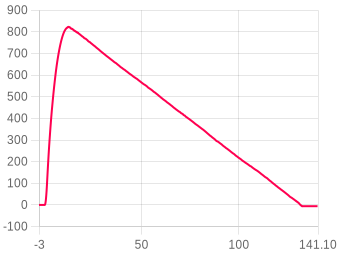
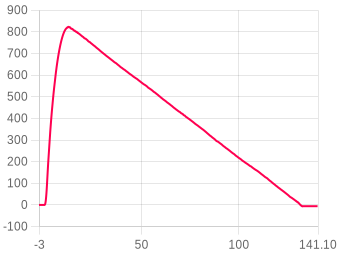
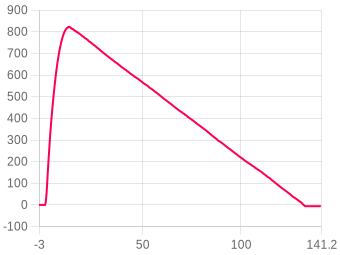
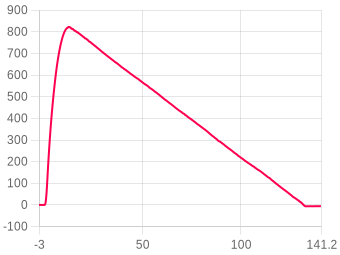
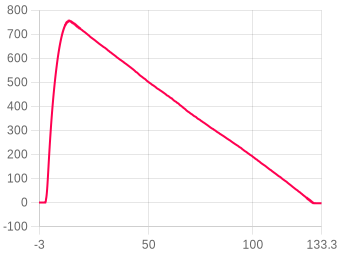
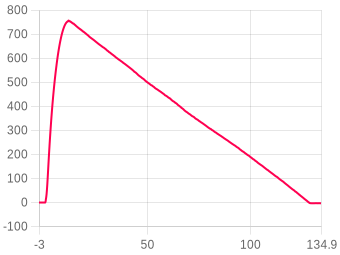
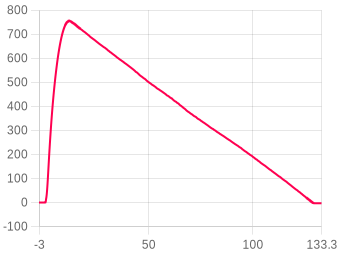
Distancia
Elija la unidad de distancia: Metros(m), Pies(ft), Millas(mi) o Kilómetros(km)
Velocidad
Elija la unidad de velocidad: m/s, ft/s, mph o km/h
Aceleración
Elija la unidad de aceleración: m/s² o G
Lil Nuke - Flight with 4 altimeters - 3
Mostrar eventos
Apogeo Fin combustión Aterrizaje Salida/Reglas Bloqueos Velocidades Eyección
Descargar
Ajustar temp. & presión ?
Imagen
Conjuntos de datos
Haga clic en la leyenda para mostrar u ocultar los datos
Zoom
Clic y arrastre, o pellizco en móvil
Comparar vuelo ?
Resumen del vuelo
Altitud
Apogeo
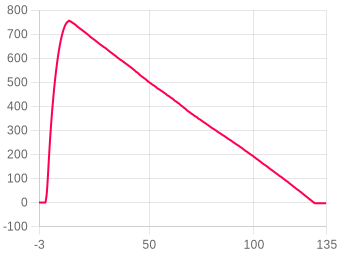
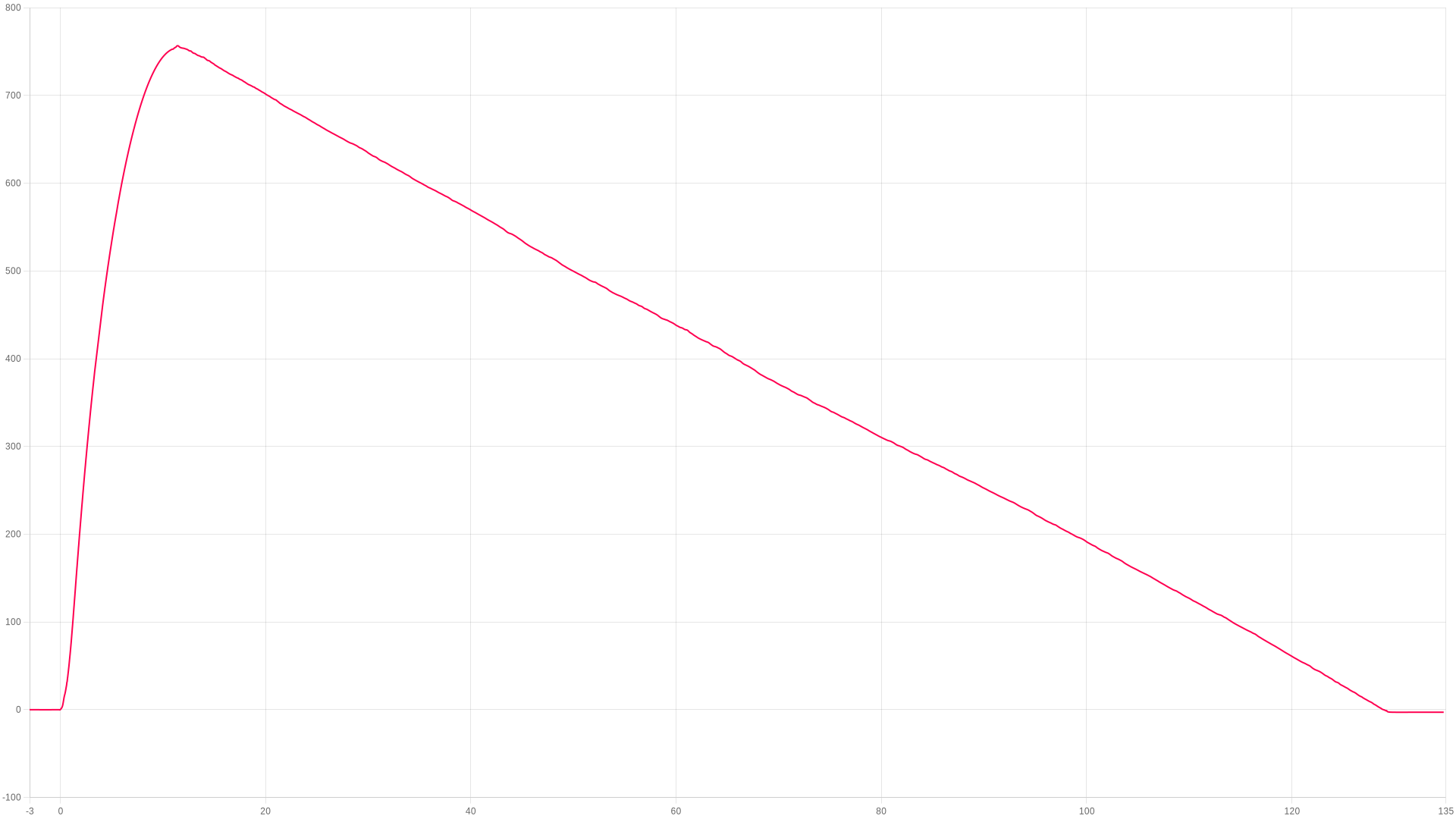
756.68 Metros
Tiempo al apogeo
11.42 seconds
Altitud fin combustión
129.76 m
Altitud vel. máx.
148.03 m
Altitud eyección
198.65 m
Altitud aterrizaje
-2.04 m
Estabilidad
Puntuación estabilidad
86.1 / 100   (Excelente)
Inclinación al apagado (20%)93.3
Cabeceo/guiñada (30%)93.7
Coning · boost (25%)77.9
Rectitud de empuje (15%)82
Launch tilt 2.6° · Coning 25.7/53.2°/s · Spin 452.2°/s · Thrust 96.2%
About this score
Worked out from the flight log between liftoff and 80% of apogee, independent of the angle the altimeter was mounted at in the airframe.
Inclinación al apagado (20%) – how close to vertical it left the rod.
Cabeceo/guiñada (30%) and Coning · boost (25%) – how much the nose swung off the rocket's own axis. The main factor.
Rectitud de empuje (15%) – how cleanly the motor pushed along the body.
Spin about the rocket's own axis is not counted against it — a fast, straight spin is stable. The line under the bars shows the raw measurements.
Velocidad
Máx. ascenso
156.91 m/s
Máx. descenso
-14.88 m/s
En fin combustión
152.759 m/s
Vel. aterrizaje
-6.141 m/s
Vel. descenso
-5.707 m/s
Vel. eyección
144.82 m/s
Recovery
Single deploy (no dual deploy detected)
Aceleración
Máx. ascenso
31.02 G
Máx. descenso
34.08 G
Máx. durante combustión
16.8 G
Prom. ascenso
1.25 G
Prom. combustión
11.64 G
Tiempos
Fin combustión (primero)
1.41 seconds
Apogeo
11.42 seconds
Posible eyección
1.863 seconds
Aterrizaje
129.3 seconds
Ángulos
Inclinación rampa
20.14°
Thrust calc pad tilt
2.6°
Incl. máx. hasta fin comb.
23.66°
Alabeo al lanzamiento
16.68°
Cabeceo al lanzamiento
10.67°
Giro máx. (comb.)
749.64 dps
Giro prom. (comb.)
394.32 dps
General
Fecha subida
14/06/26-19:43:44
Muestras de datos
11536
Tiempo total grabación
148.089 s
Prom. muestras/s
77.8
Número de bloqueos
0
Altitud grabación
42.09 m
Lanzamiento tras encendido
7m 6s
Eje de referencia
X
Batería & temperatura
Batería inicio
88%
Batería fin
82%
Temperatura inicio
28.38°C
Temperatura fin
30.12°C
Animación de datos

FLIGHT 1786

756.68 Meters

ALTITUDE
0.00m
VELOCITY
0.00m/s
ACCEL
0.00G
TILT
0.00°
PITCH
0.00°
ROLL
0.00°
YAW
0.00°
TIME
0.00s
AWAITING LAUNCH
ALT
altimetercloud.com
LAUNCH T+0.00s LANDING

BURNOUT

Motor burn complete

Nota: La animación de vuelo requiere que su altímetro esté montado en una orientación fija. Calibre sus sensores para mejores resultados.
Notas del usuario
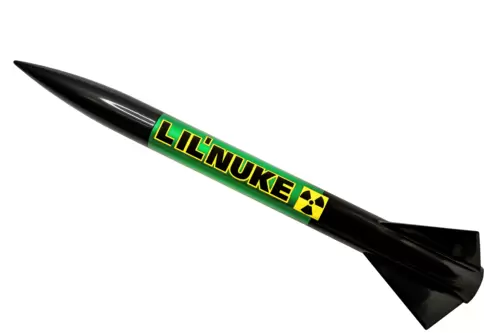
A test of 2x Mercury and 2x Nano altimeters in a Lil Nuke with a G80 Aerotech motors.
Añada este dispositivo a su cuenta para editar
Vídeo Youtube
Sin vídeo
Añada este dispositivo a su cuenta para editar
Imágenes del vuelo (0)
Sin imágenes
Cohete vinculado
✅ Active
1
My Lil Nuke #1
LOC Precision — Lil' Nuke
✈️ 7 flights linked
Type
Kit build
Diameter
57.4mm
Length
749.3mm
Dry weight
368.5g
Mod
Modified
Stages
1
Fins
3
Recovery
Parachute
Chute
61cm
Body
Loc paper tube
Sim data from sim files
MotorAltVelAccelApogeeSource
Estes A8-3135.3 m64.8 m/s29.6 G4.5 sRockSim (estes_viking.rkt)
Estes B4-4282.9 m105.3 m/s30.0 G6.1 sRockSim (estes_viking.rkt)
Estes B6-4288.1 m116.9 m/s31.0 G5.9 sRockSim (estes_viking.rkt)
Estes C6-5475.1 m171.4 m/s34.4 G7.5 sRockSim (estes_viking.rkt)
Estes C6-7483.1 m171.4 m/s34.4 G8.1 sRockSim (estes_viking.rkt)
Información del dispositivo
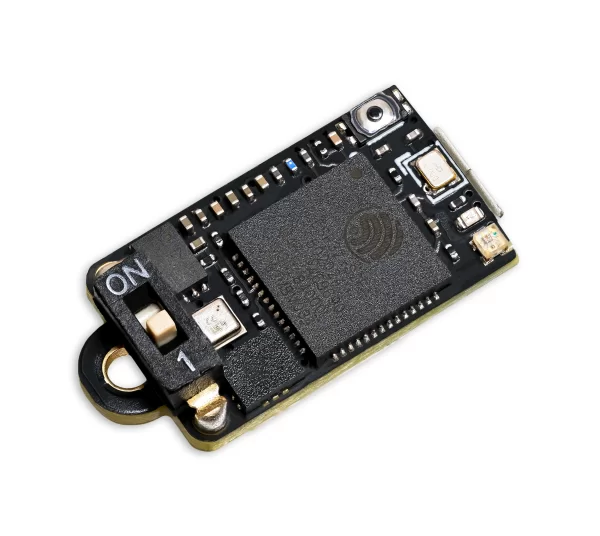
Nano V1
Este vuelo se realizó con un Nano V1.
Versión hardware
Rev 4
Versión software
1.52
Última conexión
14/06/26-19:43:44
Sensor presión
Bosch BMP 581
Acelerómetro
32G 3-axis
Giroscopio
2000 dgps 3-axis
Motores del vuelo
1st Stage
1x
AeroTech
G80T-10
Añada este dispositivo a su cuenta para editar
Combustión del motor
The dashed line is the combined thrust curve for your motors (data from thrustcurve.org), scaled so its peak matches the recorded acceleration maximum — the shape is meaningful, the absolute level is not (your rocket's weight is unknown).
Sitio de lanzamiento, fecha y hora

Haga clic en el mapa para marcar su sitio de lanzamiento. Cambie entre vista de mapa y satélite.

Clic en el mapa · Arrastre para ajustar

Lat Lng
✓ Launch location saved successfully.
✗ Could not save location — please try again.
Comparación de vuelo
Comparing against 3 other flights with the same motor configuration.
Highest apogee756.68 m 4th of 4
The maximum altitude reached above the launch point.
you
best
Best stability86.1 /100 2nd of 4
How straight it flew: launch, coning and thrust straightness combined. 100 is perfect.
you
best
Fastest velocity156.91 m/s 2nd of 4
Peak ascent velocity recorded during the flight.
you
best
Best avg burn G3.36 G 4th of 4
Average acceleration during the motor burn, in G.
you
best
Longest flight148.08 s 3rd of 4
Total recording time from launch to landing.
you
best
Lowest spin394.32 dps 4th of 4
Average spin rate during the burn.
you
best
Coldest flight0.28 C 1st of 4
Board temperature at launch.
you
best
best 0.28 C · you
🌲 Is it in a tree?-2.04 m 2nd of 4
Just for fun: whichever flight came down closest to 8 m above the launch point (roughly tree height) is the one most likely stuck up a tree.
8 m
you
best
Ajustes generales del vuelo
Esta es una captura de los ajustes utilizados para este vuelo. Visite la Visite la página Mis dispositivos y configure los ajustes..
Presión prevista
i
Set this to your local forecast pressure at sea level. This will offer you slightly improved accuracty for your flight, although it's not 100% essential every little helps!

Xcweather.co.uk is a decent place to grab pressures from for your location and time.
1013.2 mbar
Detección lanzamiento
i
This is the altitude above the launch pad altitude where the altimeter will trigger itself into recording / flight mode.

The altimeter keeps a constant average of the pressure while waiting for launch, it uses a simple algorithm and the pre-flight buffers to do this. The most recent 120 samples (~4 seconds) are ignored so your pre-trigger altitude won't effect the ground baseline.

For almost all uses we suggest keeping this on the 25 Meter (~82 feet) default settings. If you want to test your altimeter by throwing it in the air, or are planning a very low flight you may want to lower the setting.
30 meters
Sample ratio
i
The altimeter runs at 50Hz however you can record every sample or every X samples in order to extend the log time. For example if you set the ratio to 1 it will save 1:1 samples, or if you set it to 3 it will save 1 in 3 samples.
1:1 (50Hz)
Max samples
i
This is the maximum samples the altimeter will log per flight. When it reaches this amount it will stop and save the recording.
0
Recording stop
i
This setting is how the altimeter decides to stop recording. You can choose either 450 (~9s) or 900 (~18s) samples stable or it will record until the max samples limit unless you press the BUTTON in Manual stop mode.

The samples stable method waits for the devices altitude not to change for the set number of samples. This is defined by not changing by more than +/- 1.0 meters for 98% of the samples, it's a reliable method to stop the recording after landing within 8-10 seconds (300 sample) or 16-20 seconds (600 sample).
Auto: 450 samples stable (~9s)
Oversampling
i
Oversampling is a internal setting of the BMP 390 pressure sensor. It is how many samples are taken for each reading. By taking multiple samples for each pressure reading the altimeter reduces noise and increases the resolution of the output.

The sensor can run at 50 samples per second in 4X mode, so we suggest leaving it in this mode as it will offer the highest accuracy.
16x Oversampling
IIR filter
i
The IIR filter is another internal sensor for the BMP390 pressure sensor. It is a Infinite impulse response filter used to enhance pressure measurement accuracy by reducing noise. It's primarily for smoothing out rapid pressure changes.

We suggest not setting this too high as it will cause delay to changes in altitude if set very high.
COEFF 7
Pressure filter
i
This filter is a software Kalman filter that runs on the altimeters processor.

The Kalman filter uses a prediction step based on a system model and then a correction step using new measurements to refine its estimate, it creates accurate most certain results from data with noise in it.
TruePath 1.0
Sample speed
i
The sample rate of the altimeter's sensors. 50Hz takes 50 samples per second, 100Hz takes 100 samples per second for higher resolution data.
200 Hz
Hybrid mode
i
When enabled, the altimeter records at full speed during ascent then switches to half speed after apogee to extend recording time during descent.
Enabled
Sync sensors
i
The filters on the pressure sensor can cause it to lag very slightly behind the Accelerometer and Gyroscope data. The Sync sensors option detects how far out of sync these sensors are. It then corrects the Acceleration and Gyroscope readings to match the pressure sensor.
ACTIVADO (24 samples / 140ms)
Orientation
i
This is the orientation you intend to install the Altimeter in your rocket. It's needed to ensure completly accurate angles and orientation charts and reports. Check out the Manual for more information on this.
Down (text up)
IMU filter
i
The IMU filter, or fusion filter takes the data from each axis of the Gyroscope and Accelerometer to calculate the Pitch, Roll, Yaw and tilt angle from vertical. These filters can build up some discrepency over time so it's important to calibrate your sensors to minimise this.
Madgwick 6-Axis
Launch ALP
i
This is prevention against accidental launch detection.

With this disabled the launch is based only on pressure and something that creates a low pressure can trigger the flight by accident. For example pulling your nose cone off can even trigger it.

With this enabled the rocket also needs to have seen 8 samples (0.25 seconds) of acceleration above this setting in the last 3 seconds as well as the pressure drop to trigger. There is a backup trigger of 1.05 seconds of altitude being above the launch detect setting too.

There are very few situations where this option would cause issues, so we suggest leaving it on.
1.5G
Launch lock
i
When enabled, the altimeter locks out recording for a set period after power on to prevent false triggering during setup.
DISABLED
Static temperature
i
A fixed temperature value used for altitude calculation when the external temperature sensor is disabled or not connected.
15 °C
Calibración de sensores
Compensaciones de calibración usadas en este vuelo.
Giroscopio
X
2.000°
Y
0.000°
Z
0.000°
Acelerómetro
⚠ El acelerómetro no ha sido calibrado
X
0.000 mG
Y
0.000 mG
Z
0.000 mG
Vuelo
Comentarios
Comentarios
Inicia sesión para comentar.