New Nano altimeter firmware (v1.62)
Nano firmware 1.62
Release notes, covering everything since 1.60.
This is a big one. The headline is that TrueFuse 2C, the altitude fusion filter that AltimeterCloud runs on every uploaded flight, now runs on the Nano itself at save time. There are quite a few other bits and bobs as well.
It's well worth an update!
TrueFuse 2C on the device
TrueFuse 2C is our new fusion filter that helps to perfect the altitude and velocity your rocket actually flew by removing pressure sensor issues and corruption.
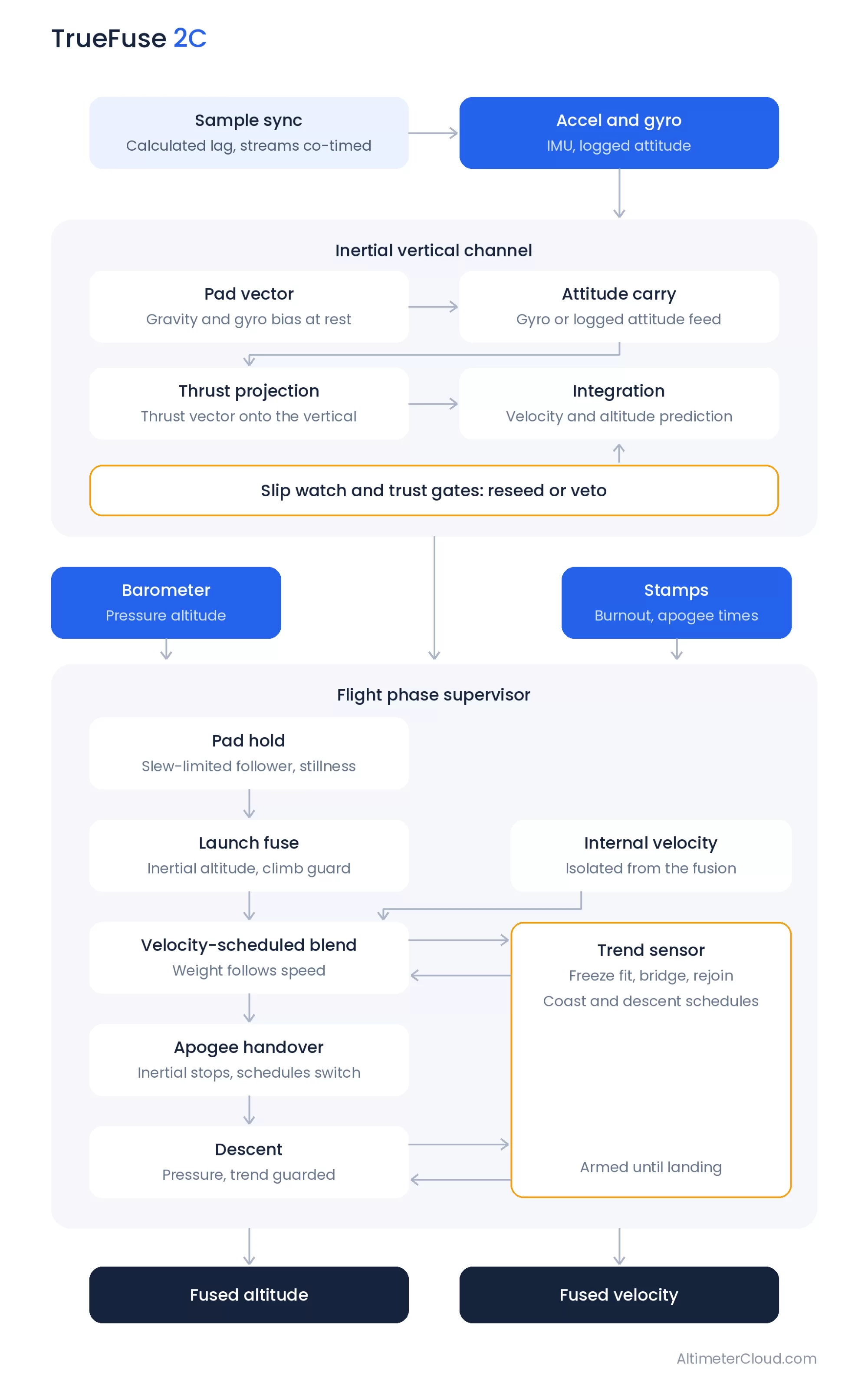
TrueFuse 2C has been developed to cope with slipping loose altimeters as well as those in fixed orienations, and that was the tricky part.
It uses the pressure, accelerometer and gyroscope to perfect altitude as well as detecting and fixing pressure events. Such events can be found during the motors burn, at higher speeds, during ejection events and many others too.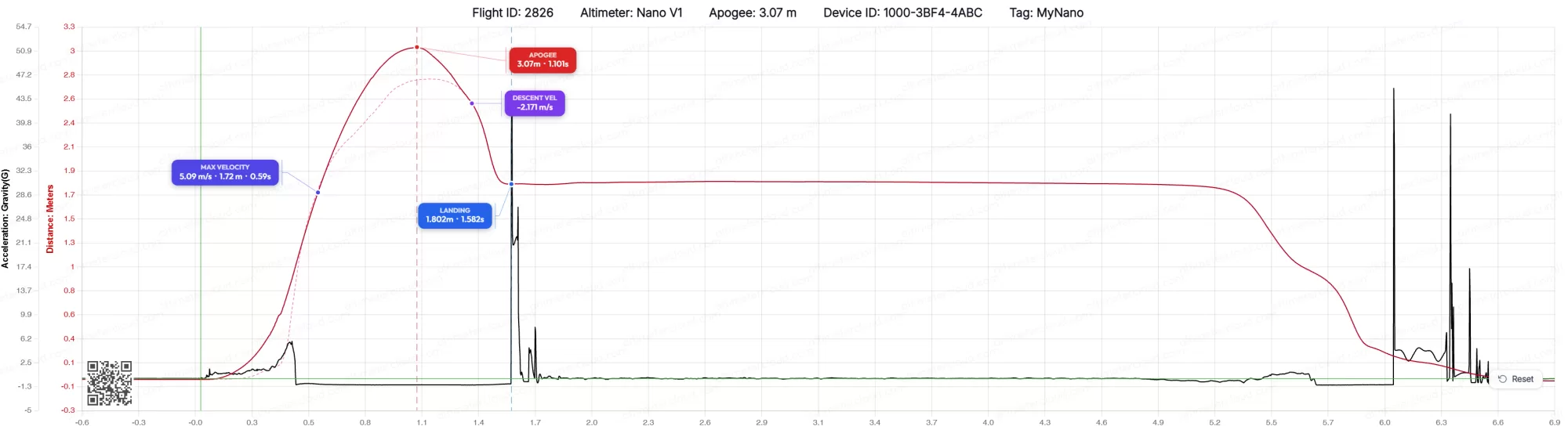
This chart shows a hand throw in my office to demonstrate the fusion filter.
The ceiling in my office is 3.10 meters, and after a few attempts this one just stopped short of the ceiling before I caught it and placed it down at the end.
As you can see the lag from the pressure sensor resulted in 2.75m apogee and the fusion output gave the correct 3.07m.
Velocity, simplified
The old adaptive velocity estimator is gone. The velocity column is now a plain time stencil over the final fused altitude trace: simpler, honest, and it cannot disagree with the altitude it sits on.
Better event detection
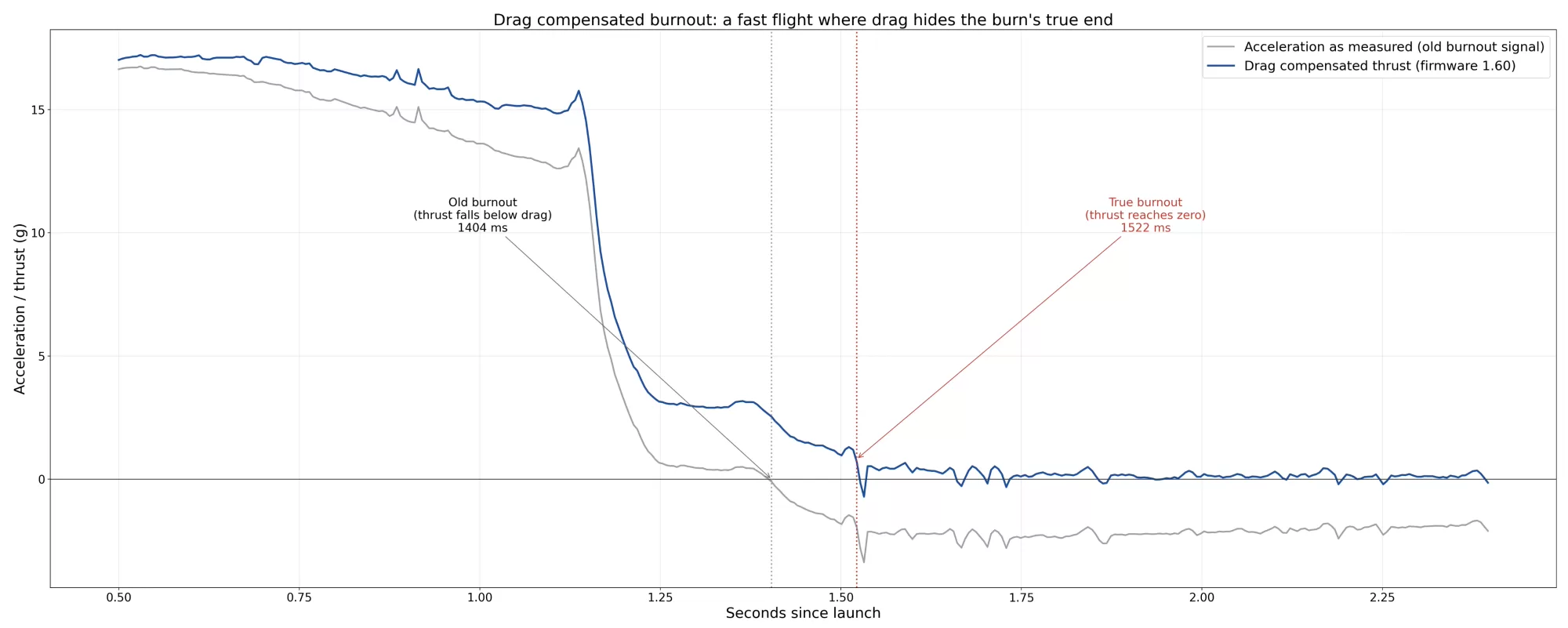
Burnout look-back now requires thrust to be sustained for 50 ms before it will call it thrust, so a single noisy sample can no longer fake a motor. Ejection detection gained a verification pass with proper bounds: it arms shortly after burnout, is deliberately not gated on apogee (delay grains do not read the flight computer's opinion on when apogee was), and must complete before touchdown so the landing impact cannot masquerade as a charge.
Launch confirm without flash writes
The launch confirm cycle is the busiest loop of the whole flight: pre-buffer selection, the pad scans, the sample sync shift and the t0 refine all land in it at once. It no longer writes flash at all. The recovery header is built in RAM during that cycle and programmed on the next pass, keeping SPI programming, with its cache and interrupt stalls, off the one loop least able to afford it.
Rail angle measurement
The Nano now measures the angle it sat at on the pad, from the accelerometer during the stillness before launch, and reports the angle, the confidence, and whether the mount moved between the scan and liftoff. You will find the new lines in the flight info page. Useful for weathercocking arguments, and occasionally for discovering the rail was not as vertical as it looked.
Saturation reporting
IMU saturation detection was reworked to catch railed axes at the raw sample level, and the flight header now carries the statistics. If your motor out-accelerated the accelerometer's range, the log will tell you rather than leaving you to wonder why the numbers look clipped.
Calibration quality report
Accelerometer calibration now writes a quality report into the logs: how good each axis actually is, on-axis and cross-axis, against defined acceptance windows. Gyro calibration was reworked alongside it. If a calibration is poor you will now know at calibration time, not three flights later.
Calibration system improved
The calibration system now differentiats valid and invalid samples better than it did previously leaving only the correct samples to average for the offset.
Battery rundown test
A new tool for the curious: the Nano can record a battery rundown curve to flash, stamping the voltage every 30 seconds until the pack reaches the shutdown threshold. The report is honest about incomplete runs: if power was pulled or the pack went flat without tripping the threshold, it says the test was cut short rather than pretending the curve is complete.
Bits and pieces
- The CPU now runs the save at 160 MHz to keep the post-flight processing time reasonable.
- Barometer polling is now per sensor: 120 Hz on the BMP581, 80 Hz on the BMP390.
- The flash recovery region has an explicit size and is erased once recovery is finished with it, and the battery test store lives in its own region after it.
- The free-space forecast for .aclz saves was rebuilt around measured file sizes, so long flights trim predictably instead of failing to save.
- The flight info page gained the TrueFuse block, rail angle and saturation rows, and timing and memory diagnostics for the save itself.