The Jupiter is nearly here
The Jupiter Series
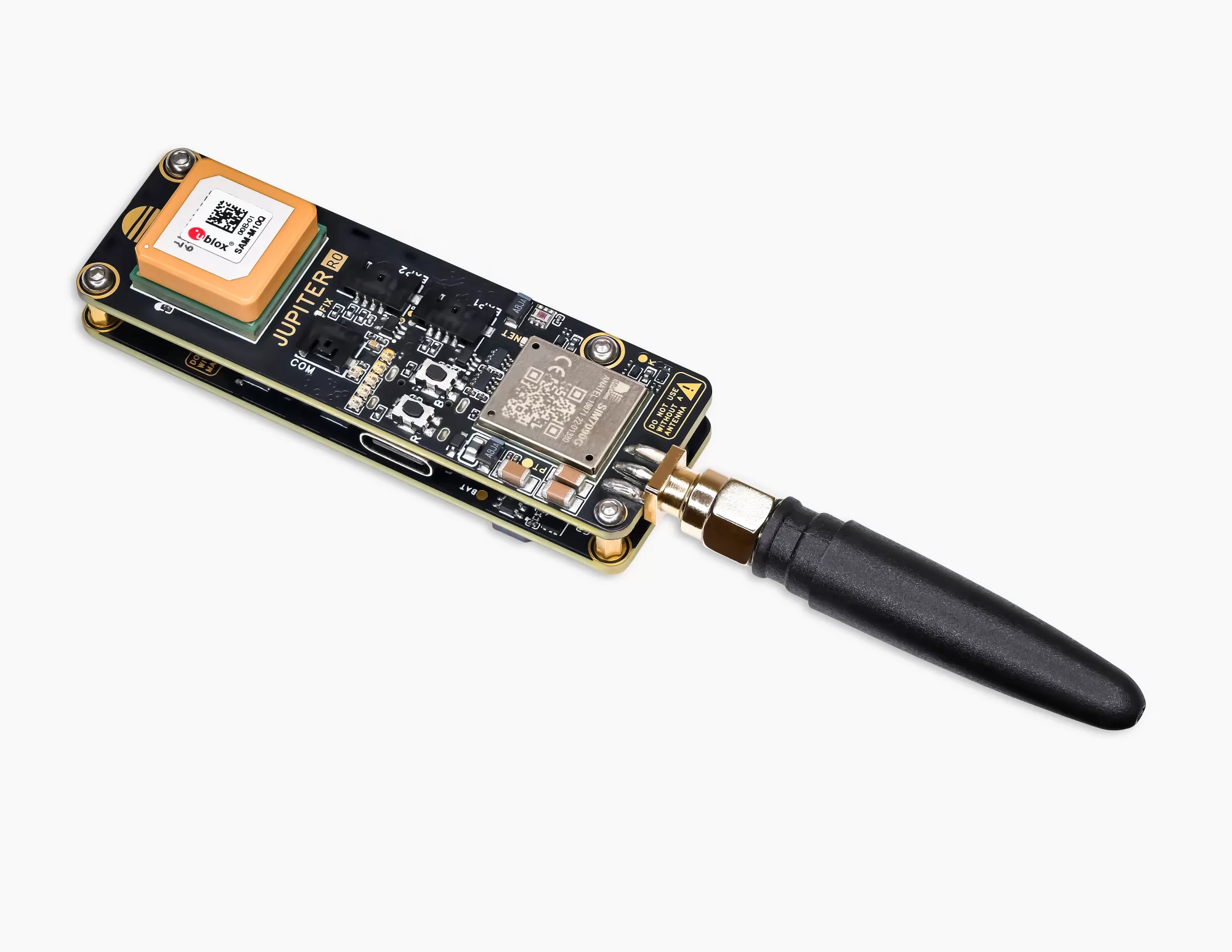
Our flagship flight computer & tracker first revision test boards have arrived.
And the best bit is every part on them is working as planned.
The Jupiter comes with a 10 year line rental included SIM card and cellular communication. It includes 500MB of data which is sufficient for 100-500 flights depending on your settings. Should you ever run out, top ups are affordable putting the cost per flight for data at just pennies.
The Jupiter will be a powerful data logger and flight controller for model rocketry. It offers a moduler design with everything you need for most uses already included, however you can expand it as needed too.
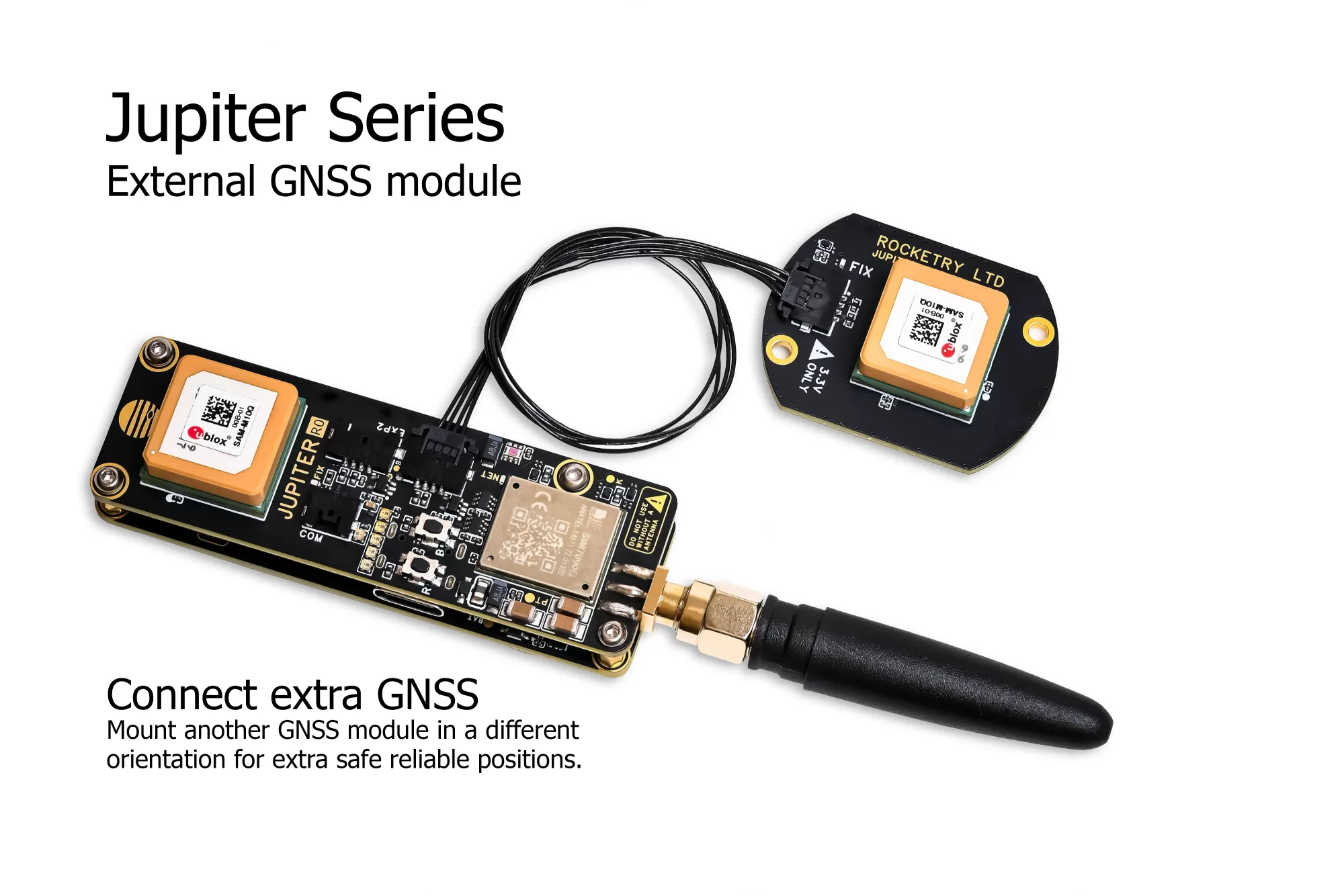
From extra GNSS expansion boards for reliable positioning in any orientation, through to LORA radio communications, extra outputs and servo controllers too.
The four onboard expansion ports can be used directly too as GPIO ports for servo signals or I/O use as well as for expansion modules. This gives you up to 8 I/O ports from those expansion ports on top of the 3x high current outputs and other general purpose switch connectors and the ADC input.
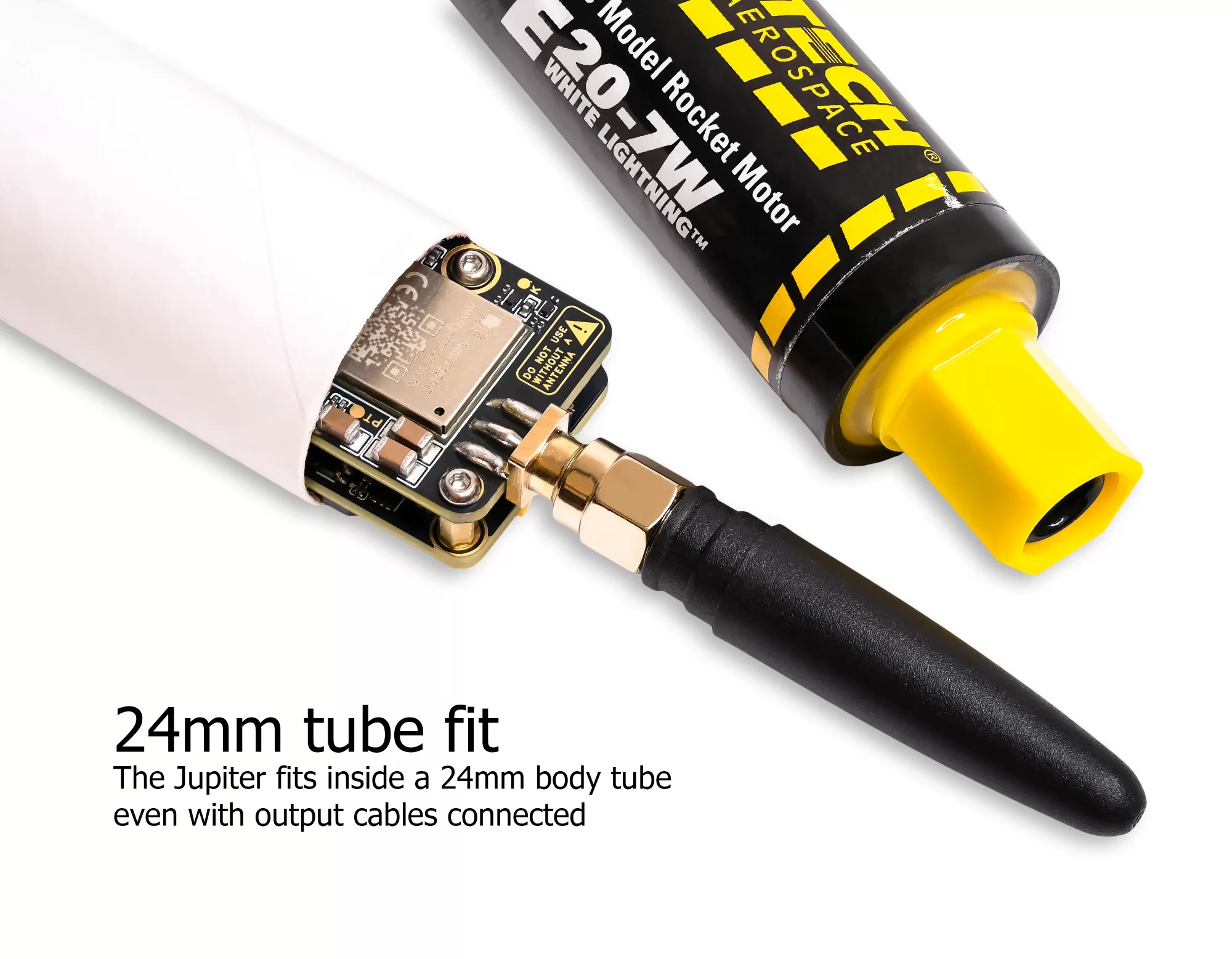 The Jupiter is designed to fit within 24mm inside diameter tubes, opening up reliable tracking and flight control needs to smaller rockets.
Connections are Molex clip in types that wont vibrate loose, allowing a solder free plug and play flight computer that anyone can use without hassle.
The 2-pin switch and 4-pin small connectors are Molex 1.0mm pitch PicoLock.
The expansion port 4 is a StemmaQT type friction fit connector for compatibility with third party devices.
The high current outputs are 2-pin Molex Micro-Fit 3.0 connectors capable of 8.5 Amps current.
The battery connector is a XT30.
The onboard super capacitor and active brownout protection monitors if enough power is available to power the system. This allows it to run from a single battery safely and will regulate output current as needed to prevent the main system from running out of power if a battery can't supply enough current to fire a output fully on and run the device.
The onboard super capacitor has enough capacity to always fire outputs fully for 5 seconds before action to mitigate current is taken.
The Jupiter also uses output drivers rather than direct mosfets. This offers diagnostic information and protection from damage for reliable long term use. It also avoids the situation of a failed mosfet you're not aware of causing a safety issue.
The output resistance monitor is so accurate it can tell the difference between a short circuit and a healthy igniter which a standard continuity check can not. You can be sure of wiring faults before you launch as a result.
Expansion ports each have their own unique current limiting LDO regulator. This ensures a Faulty or greedy expansion port setup can't damage or brownout the main flight computer.
What's onboard?
The Jupiter has 14-layers of PCB circuits. A high precision 8-layer top mother board and a heavier duty precision daughter board with 6-layers. The daughter board handles most of the high power use so has thicker copper and wide copper trace pours for power circuits.
PCB Side 1 - Motherboard - The top side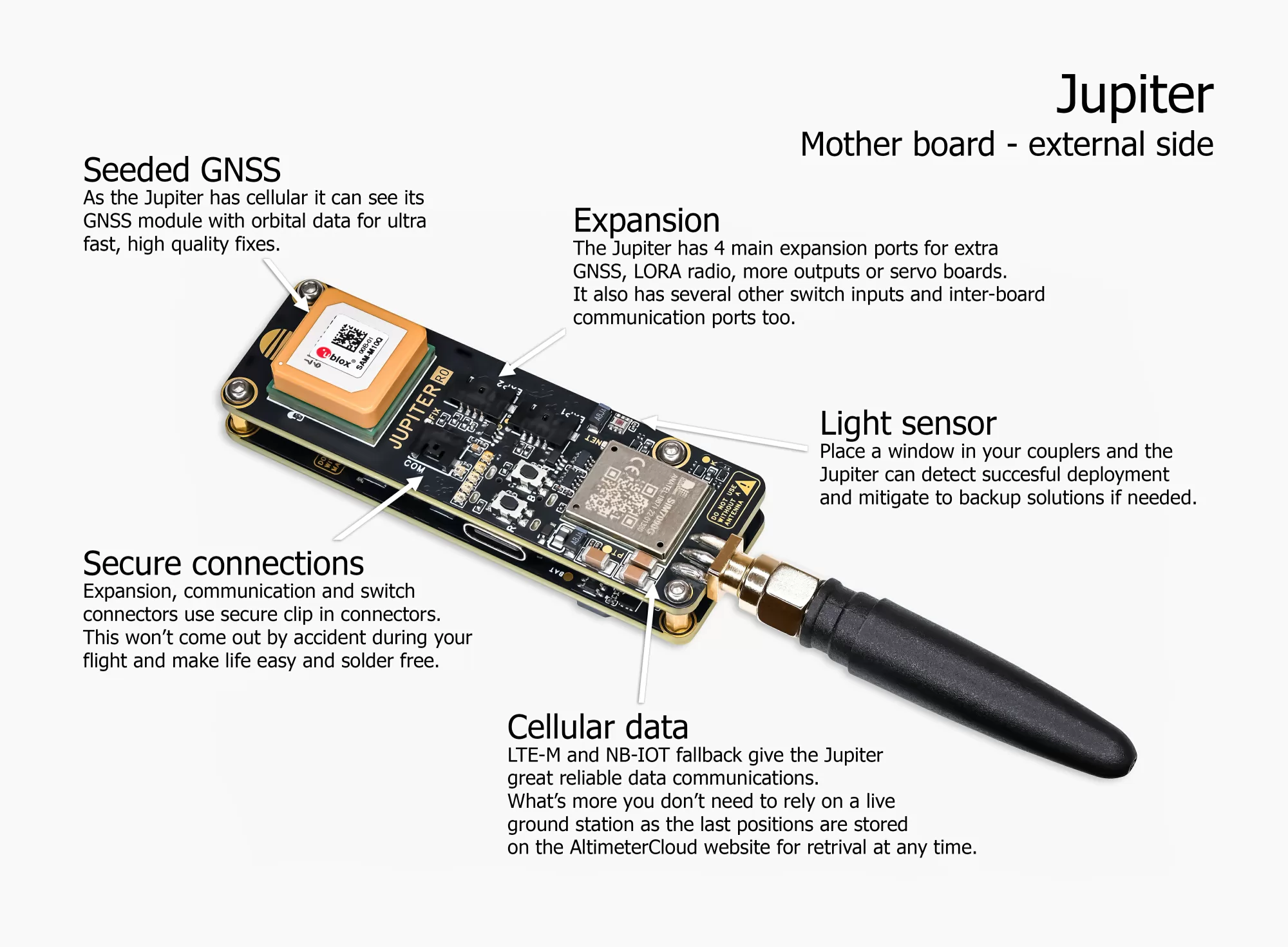
- U-Blox SAM-M10Q GNSS. This module is activly seeded with orbit data over the cellular offering really fast fixes and good quality fixes even with part of the sky obscured.
- Cellular data modem. This modem offers LTE-M with NB-IOT fallback, offering incredible reliability and data connection throughout most of the world with ease. Tracking is logged on the AltimeterCloud website so you don't need to rely on a radio link to a ground station to track down your rocket.
- Two of the four expansion module connectors using Molex locking ports so they won't come out by accident.
- Six multicolour status LEDs to show you up to date status information.
- Light sensor. This can be used to confirm a successful deployment by placing light windows in your coupler amongst other uses.
- COM port. This can be used to let multiple Jupiters speak to each other should you need for advanced rules or safety uses.
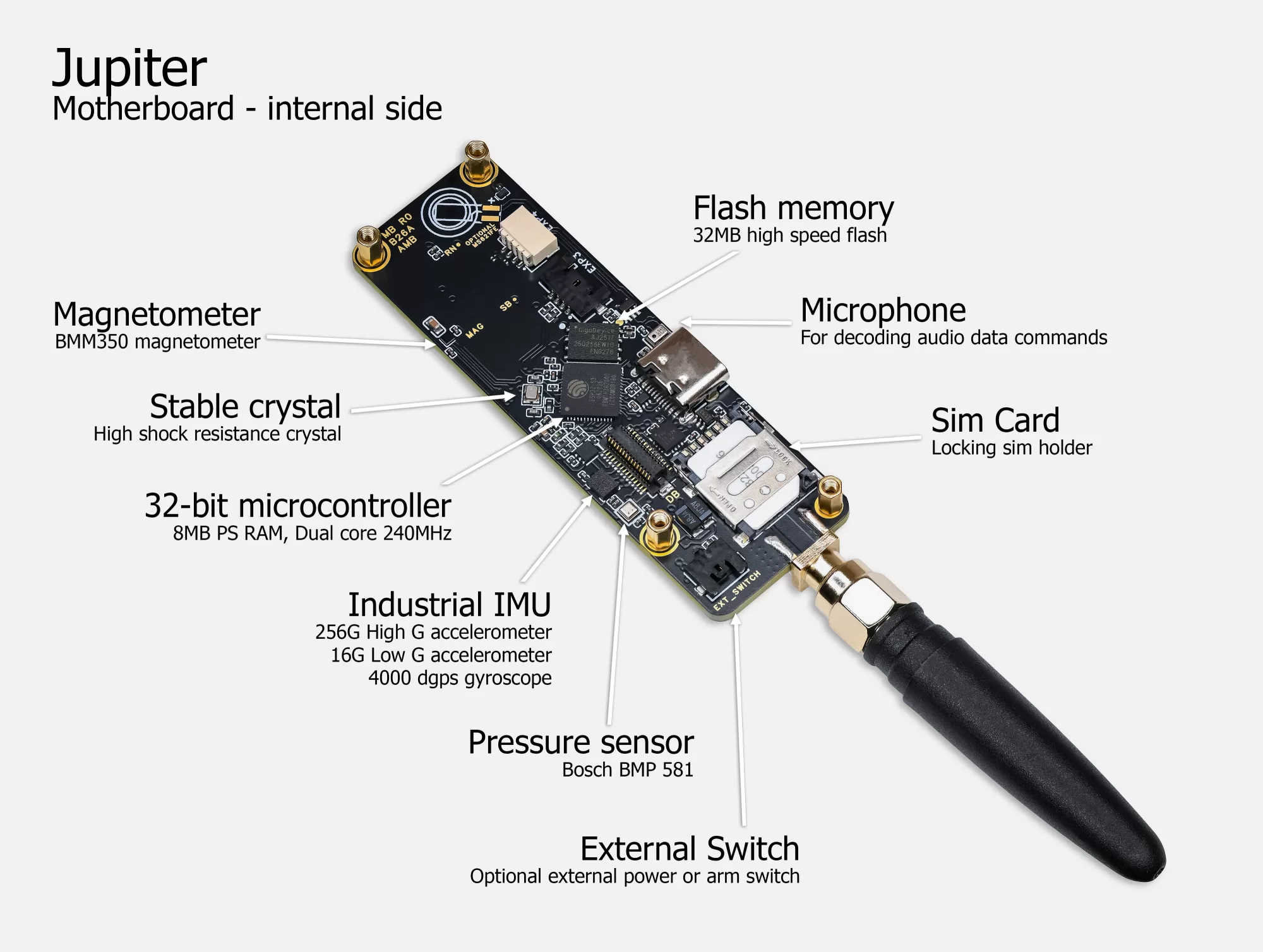 PCB Side 2 - Motherboard - inside
- 32-bit dual core 240Mhz processor
- 32MB high speed SPI flash memory
- Sim card holder for the cellular modem
- Bosch BMP581 pressure sensor
- High quality IMU with dual accelerometers (3-axis 256G, 3-axis 16G) and 3-axis 4000dgps gyroscope
- BMM350 3-axis magnetometer
- High shock resin filled crystal
- Expansion ports 3 and 4 for expansion modules.
- External switch conenctor, molex clip in secure connector.
- USB-C port for direct file access, updating or serial data streaming. It can also be used to power the device for all functions except the high current outputs.
- 30 pin inter-board connector
- Microphone, this allows for decoding coded audio commands that you can send the Jupiter via a mobile phone app
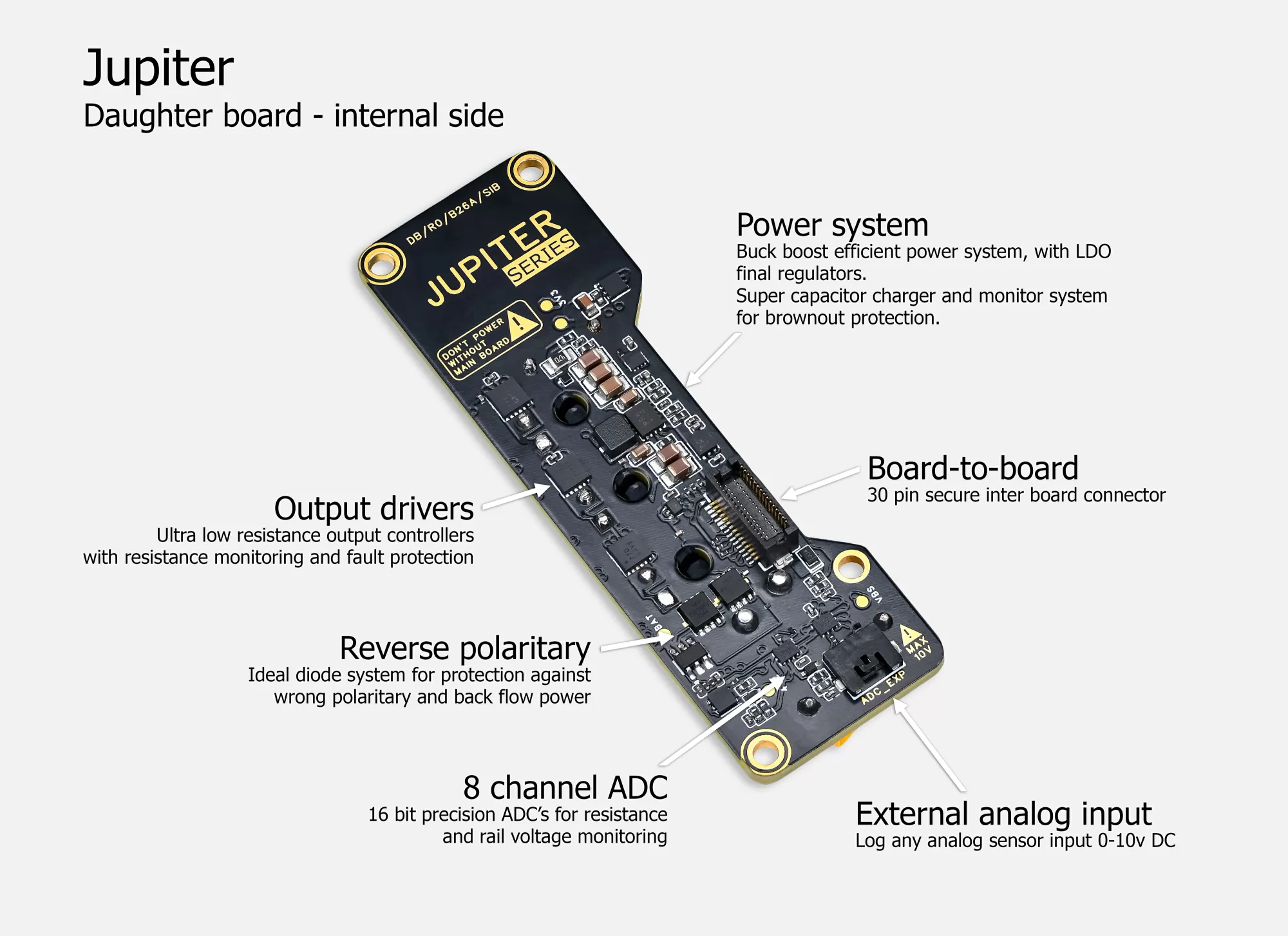 PCB Side 3 - Daughterboard - Inside
- Three high current output driver chips. Up to 20A burst current and 8-10 amps continuous current each. Thermal and over current protection. Power good outputs and resistance monitoring on each output allows for advanced safe control of outputs ensuring reliable use and confirmation of success. The resistance monitoring is so precice is can tell the difference between an igniter and a short circuit before you launch. Outputs are just 3.6mOhm resistance typically ensuring as little waste heat as possible is generated during use.
- Ideal diode controller and dual parrallel low resistance mosfets control reverse polaritary protection and backflow current is prevented to the battery also.
- 8 channels of precision 16-bit ADCs. These allow both the resistance monitoring of output channels as well as a complete power system monitor. We're also able to monitor the state of charge of the super capacitor to take action and ensure brownouts can not happen should outputs be consuming too much power for the battery.
- Molex secure clip in external ADC input. You can use this to monitor any other analog data or sensor you want and log it to the flight log. (0-10V DC supported with adjustable range for improved resolution).
- The power system uses a high efficiency low noise buck boost system that then drives LDO regulators to give extra clean power rails for the sensors, processor, GNSS and cellular modem. We are able to control this system to operate in efficient mode during pad waits and extra low noise mode during flight.
- Super capacitor charging and release circuit. This charges the super capacitor slowly yet allows it to dump it's power as needed via an ideal diode. This ensures we can manage the power with time to spare and avoid any chance of a brown out when firing outputs.
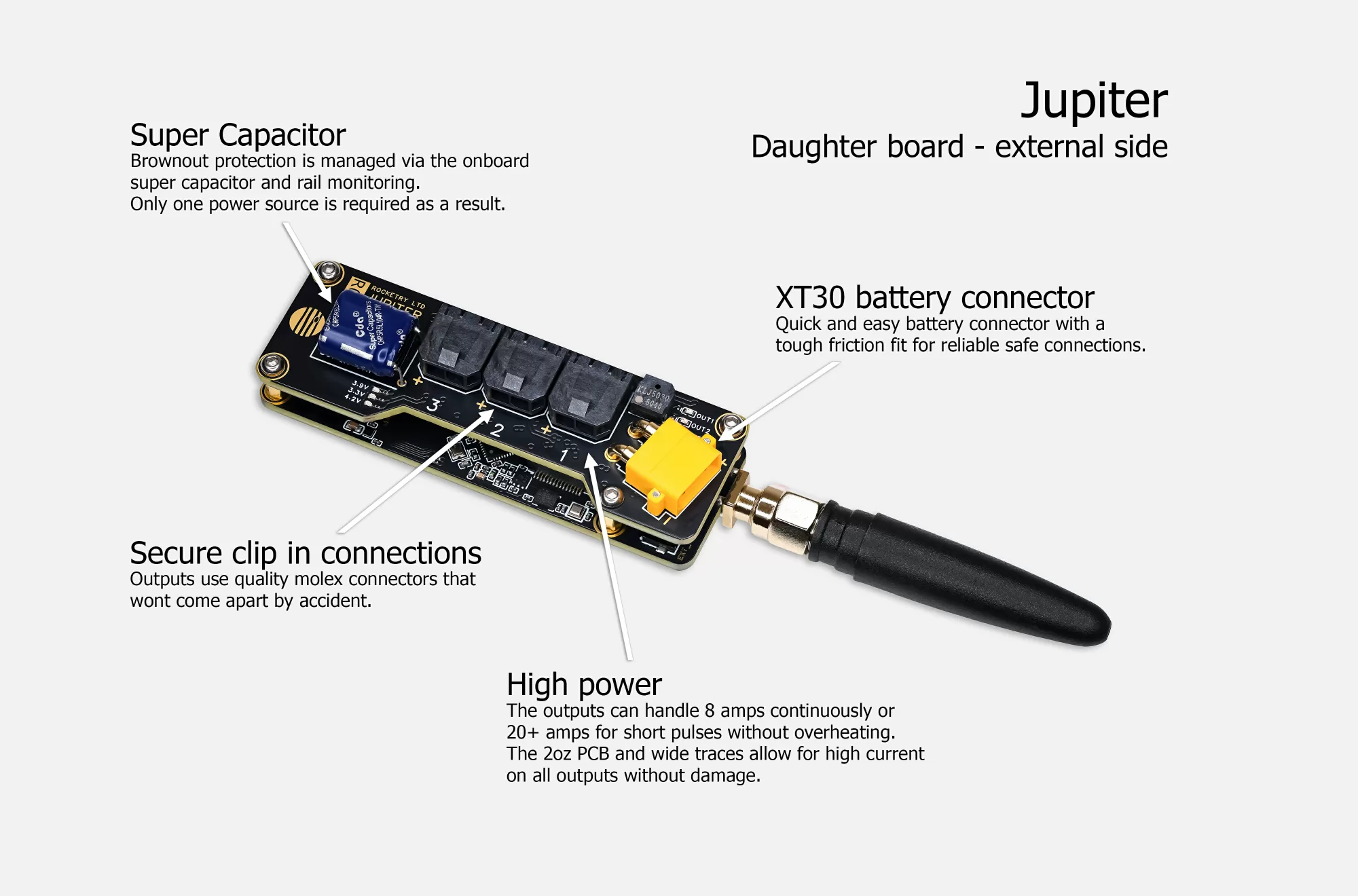 PCB Side 4 - Daughter board - The connection side
- 0.1F Super capacitor. This is sufficient to power the system for 8-10 seconds with no power at all available from the main battery. Plenty for us to make decisions about current limiting outputs to ensure enough power is left for the boards operations.
- Secure clip in Molex output connectors. These connectors can cope with 8 amps continuous power and 20amps for short bursts. They also won't come out without you physically pressing the release tabs. You can use the Jupiter without any soldering needs at all or risk of bad connections.
- XT30 battery connector. This tough tried and tested friction fit battery plug can supply up to 30 amps from a 1S to 4S LiPo to the Jupiter. We suggest a 2S LiPo but the choice is yours. Just plug it in and you're good to go, hassle free.
- Buzzer for audible notices of state(s).
- Power rail test LEDs these will light up for 5 seconds on power up to verify the power system is working correctly.
- 2oz copper PCB with extra wide trace pours ensure reliable power delivery from the battery to the high current outputs.
General Specifications and Options
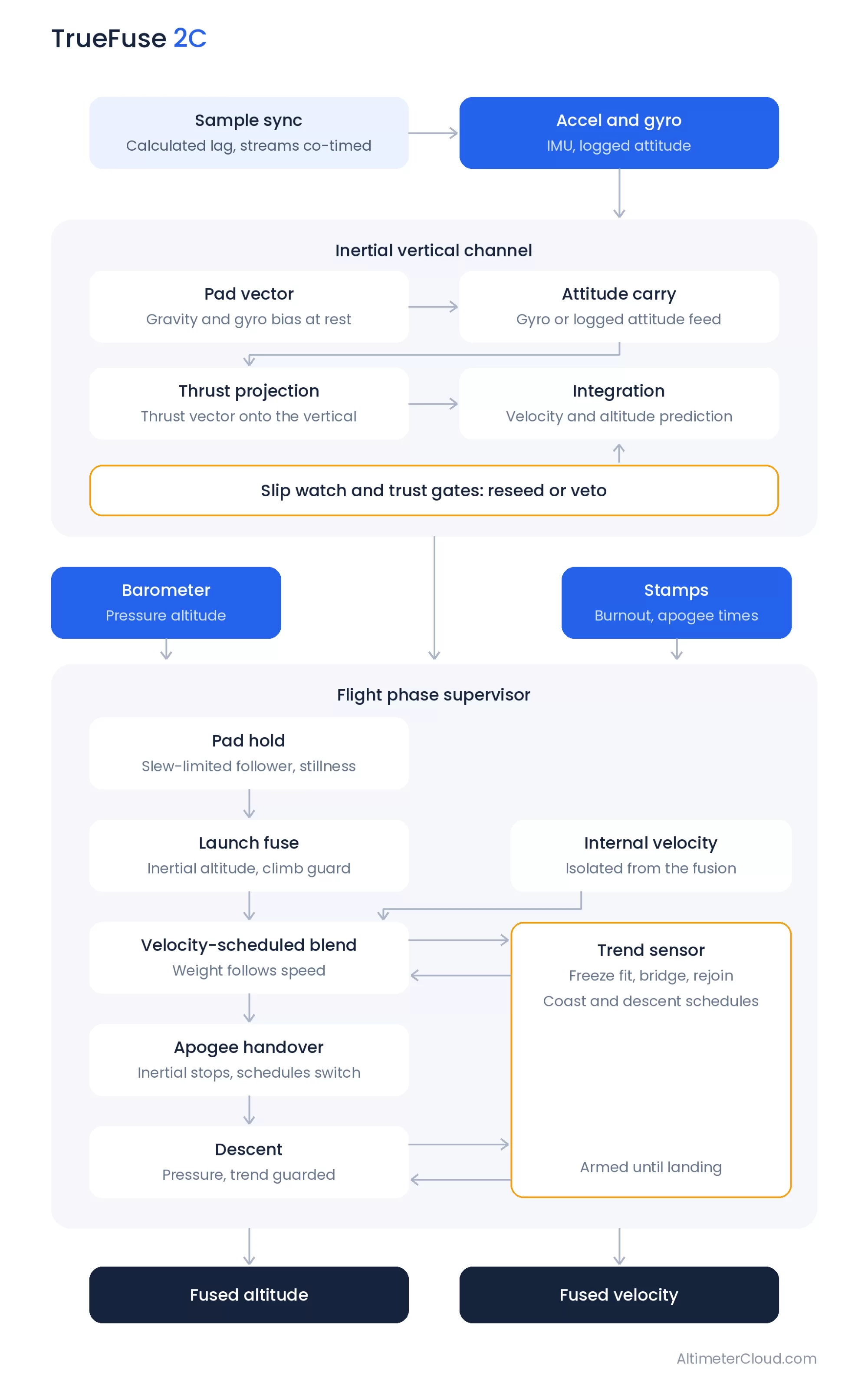
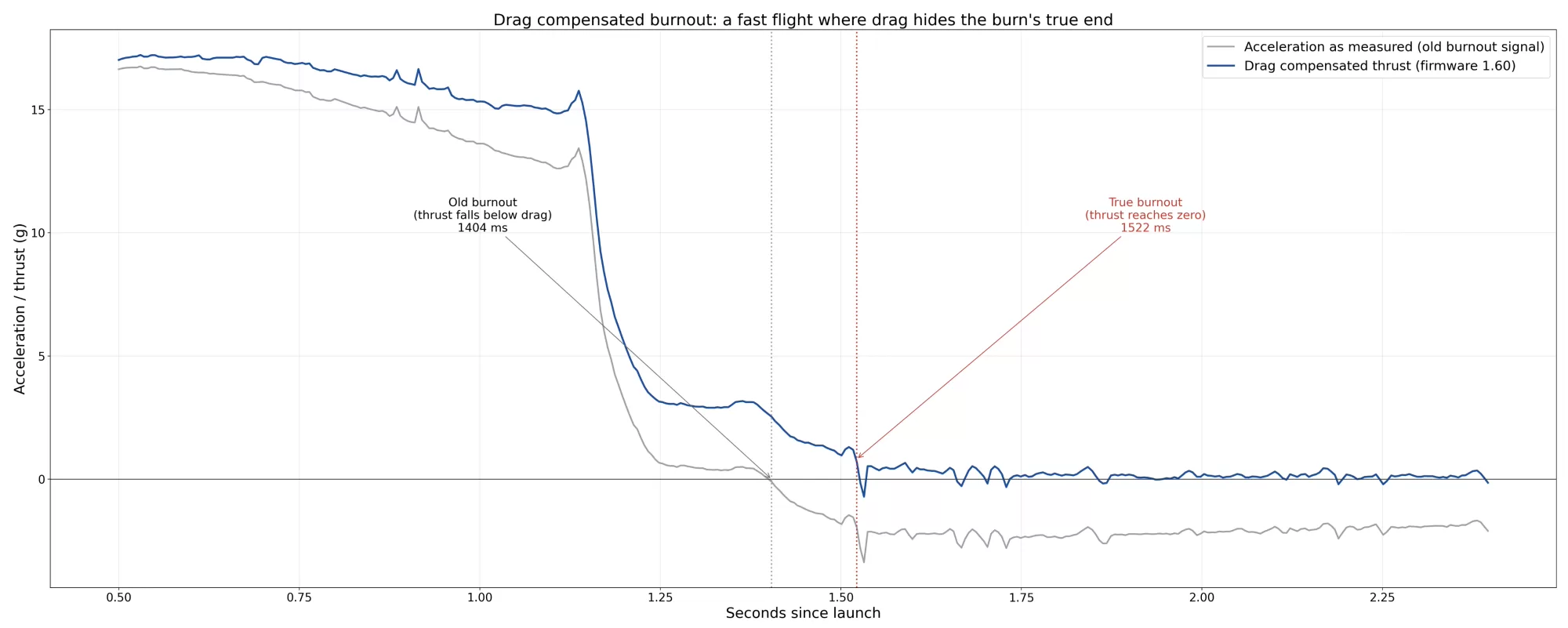
 The Jupiter offers 600Hz logging by default as well as advanced rule management and tracking.
You can add extra GNSS and other modules as needed to expand your board. This gives a unique advantage that you can mount antennas in multiple directions to ensure reliable fix no matter how your rocket lands.
The cellular modem comes with a 10 year line rental SIM card and plenty of data for over 100 flights. Top up's are cheap beyond that and permits full tracking and flight log uploading to the Altimeter cloud.
You might find your flights are already uploaded before you even recover your rocket!
The LTE-M cellular data offers great reliability over 4G and the NB-IOT failsafe fall back has reliable long-range coverage in many countries at sites where LTE-M is not available.
As the Jupiter has cellular data available it seeds live satelite orbit data from the Internet for stronger and faster GNSS fixes. This also ensure extra reliability with partial view of the sky.
Logged data by default
- GPS position data at 10Hz
- Pressure and pressure altitude at 80Hz (1280Hz effective samples)
- Acceleration data at 600Hz
- Gyroscope data at 600Hz
- Magnetometer data at 400Hz
- Rocket angles at 600Hz
- Light sensor at 10Hz
- Output resistance at 50Hz
- Power rail monitoring at 50Hz
- Battery and Super capacitor monitoring at 50Hz
- Daughter board temperature and Motherboard temperature at 10Hz
- External ADC input at 50Hz
- Rule states and trigger points
- Modem state
- GNSS state and information
- Output power good state at 100Hz when outputs are ON
- Connected external modules and their state
- I2C bus errors
- Commands and times via Cellular, magnetometer action and encoded audio commands.
Please get in touch with us if you're interested in any further information or would like us to let you know when the Jupiter is available.