Burnout detection is performed using the acceleration sensor. On its own, raw acceleration can't tell thrust from drag, so Jupiter also uses the orientation it measured while sitting on the pad to know which way it is installed in your rocket. This means it can be mounted at any angle, in any orientation, and burnout detection works identically.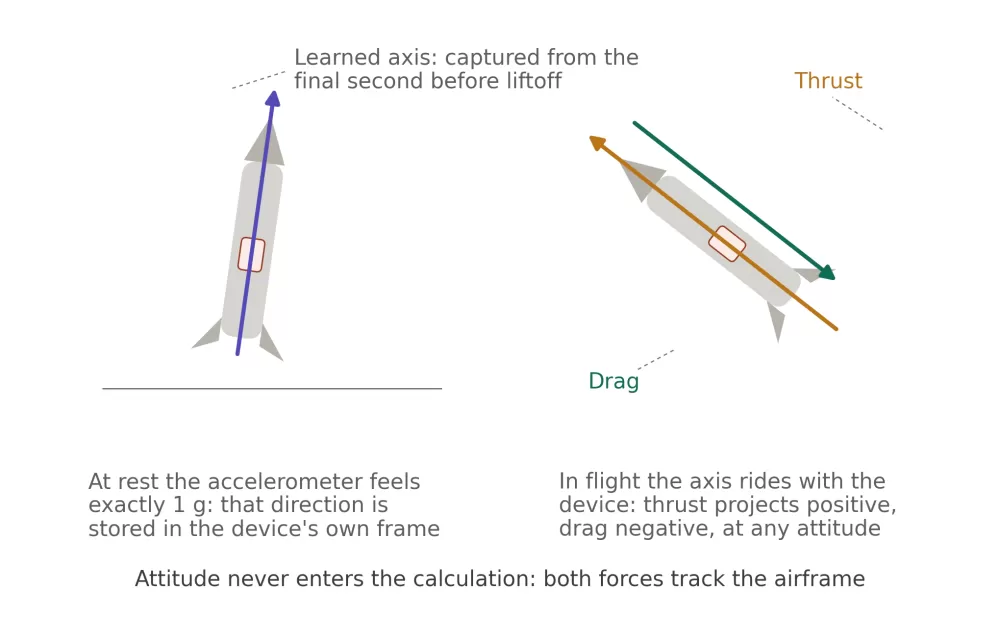
Once launch is detected, Jupiter looks back through its recorded history to the moment just before the motor lit, while the rocket was still perfectly at rest on the pad. At rest the accelerometer feels exactly 1 g, and the direction of that 1 g tells Jupiter which way "along the rocket" points relative to its own body. That direction is stored and frozen for the whole flight. Because it rides with the device, thrust always reads as positive along it and drag always reads as negative, no matter which way the rocket is pointing or how it arcs over. The rocket's attitude never enters the calculation.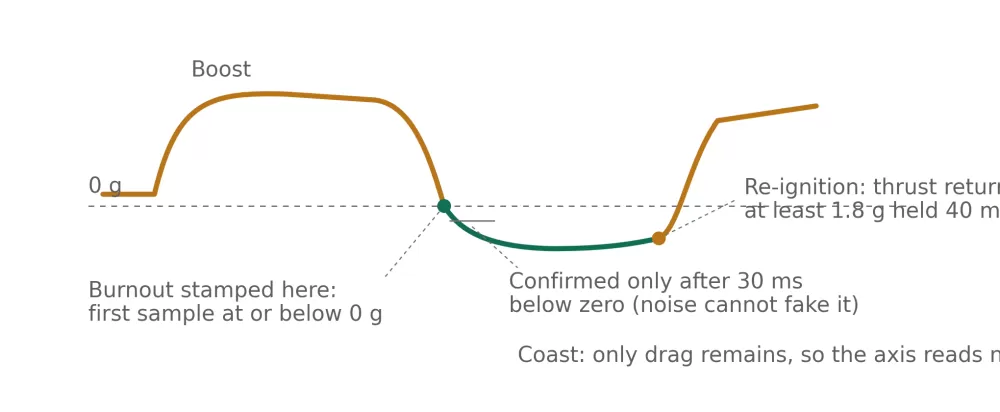
The primary detection method watches the acceleration along that stored direction. While the motor burns it is strongly positive; the instant thrust ends, only drag remains and it goes negative. That sign change is burnout, and it is unambiguous, so every crossing is logged as a burnout point, with the timestamp placed at the moment the crossing actually happened rather than the moment Jupiter finished confirming it. When thrust returns, that is logged as the next stage igniting, and the method re-arms for the next burnout.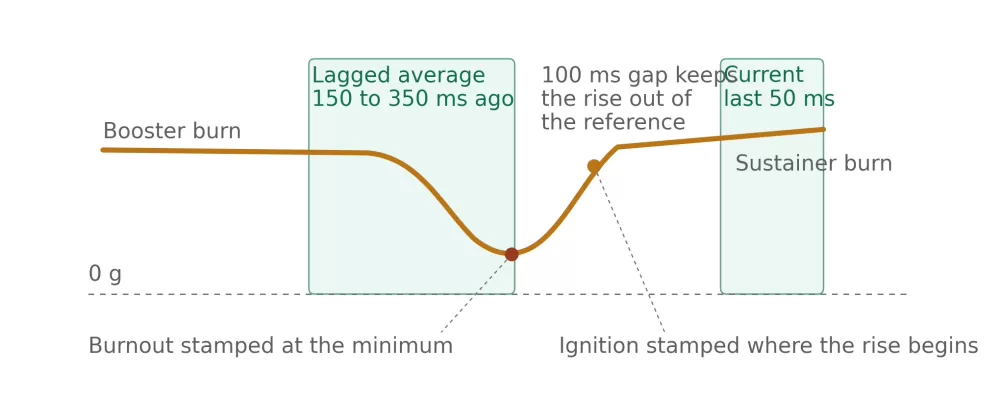
Some staged flights never show that sign change. With a zero-delay staging setup, the booster's ejection charge lights the sustainer while residual pressure is still thrusting out of the spent motor, so acceleration dips but never goes negative. A secondary method catches these: Jupiter continuously compares the average thrust from a moment ago against the thrust right now, and a significant sustained drop followed by a significant sustained rise is the signature of one motor dying as the next takes over. Motors never gain thrust at the end of their burn, so this shape can only mean staging. The burnout is timestamped at the lowest point of the dip and the ignition where the rise begins. Between the two methods, Jupiter records up to five burnout and ignition events per flight, and burnout detection ends at apogee.