Our Nano altimeter is an extremely small but incredibly capable model rocketry altimeter. At 1.65 grams and only 10 mm wide, you should be able to fit it into just about any model rocket going and log up to 38,000 samples of data at rates up to 833Hz throughout your flight.
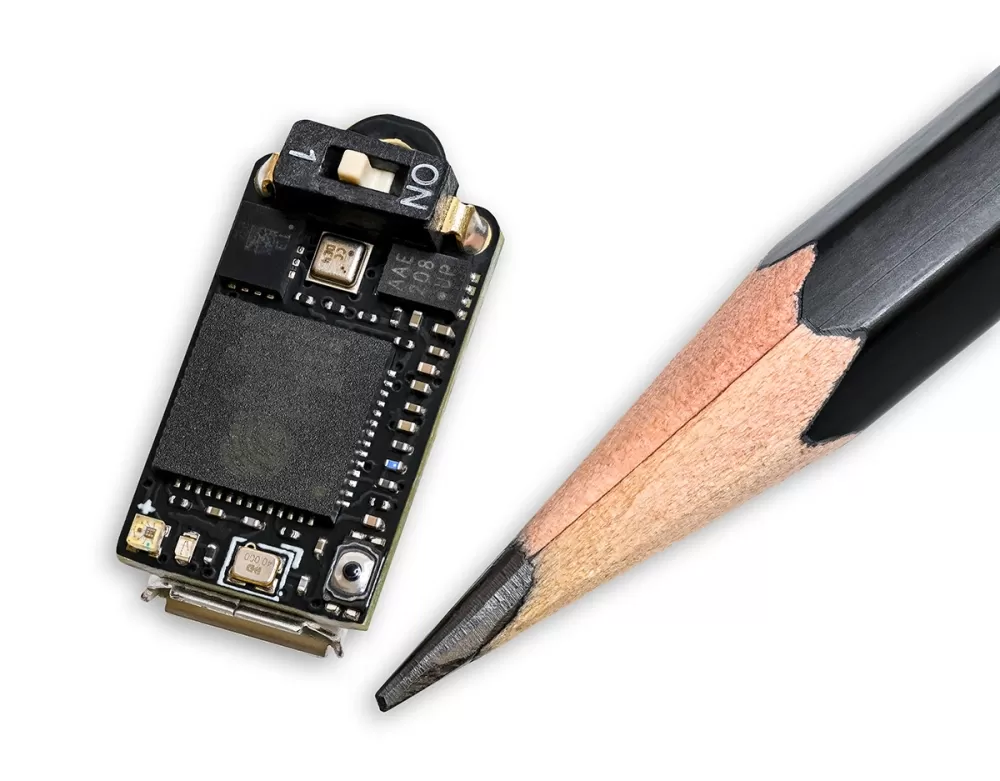
It logs barometric altitude and velocity and, on Revision 4 boards, acceleration, gyroscope and angle data too. It has its own rechargeable battery and charging IC, and it's especially handy being so small for competition flights or record attempts.
Every flight log is sealed with a cryptographic digital signature (Ed25519), so it can't be altered without the log checker catching it and refusing the verified genuine tick.
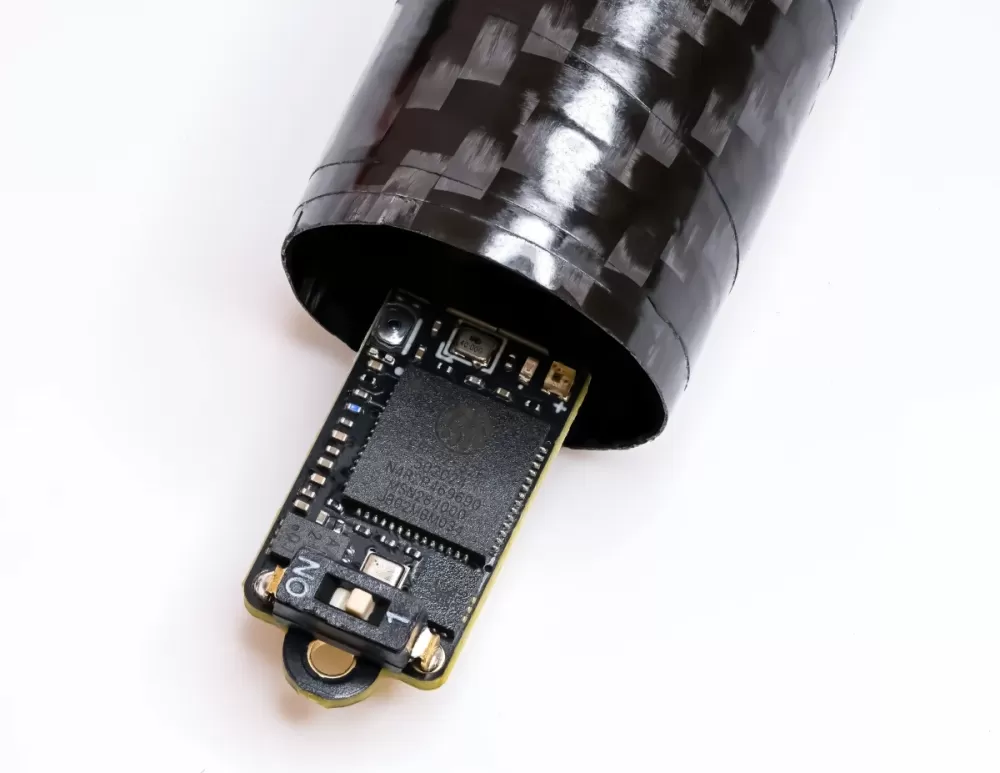
Small enough to slide into the narrowest body tubes.
What's onboard?
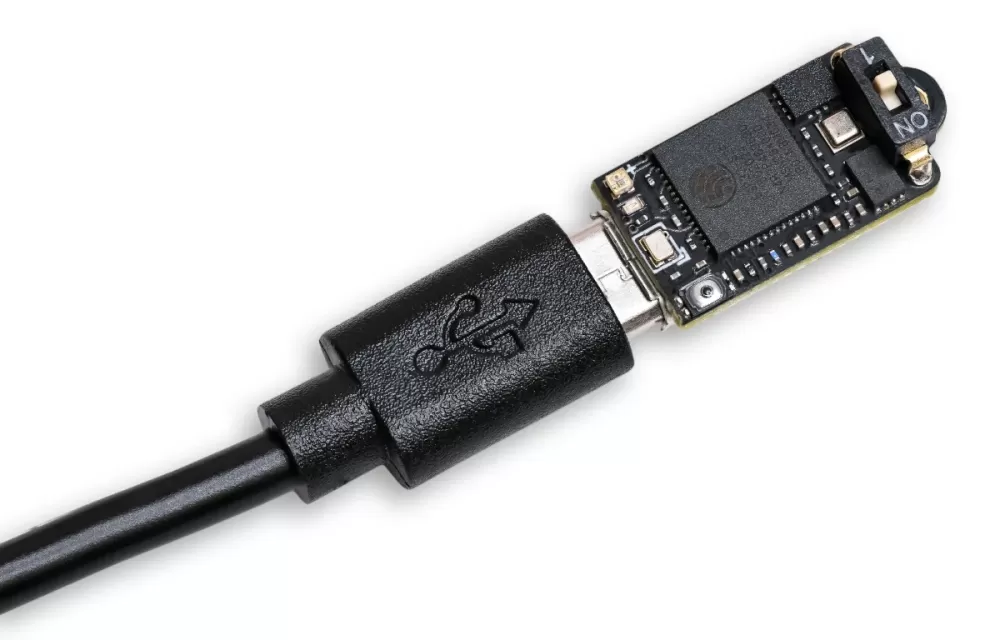
Despite its size, it has a 240 MHz, 32-bit microprocessor, battery charger, multi-colour status LED, accelerometer, gyroscope and even a micro-USB port all on board.
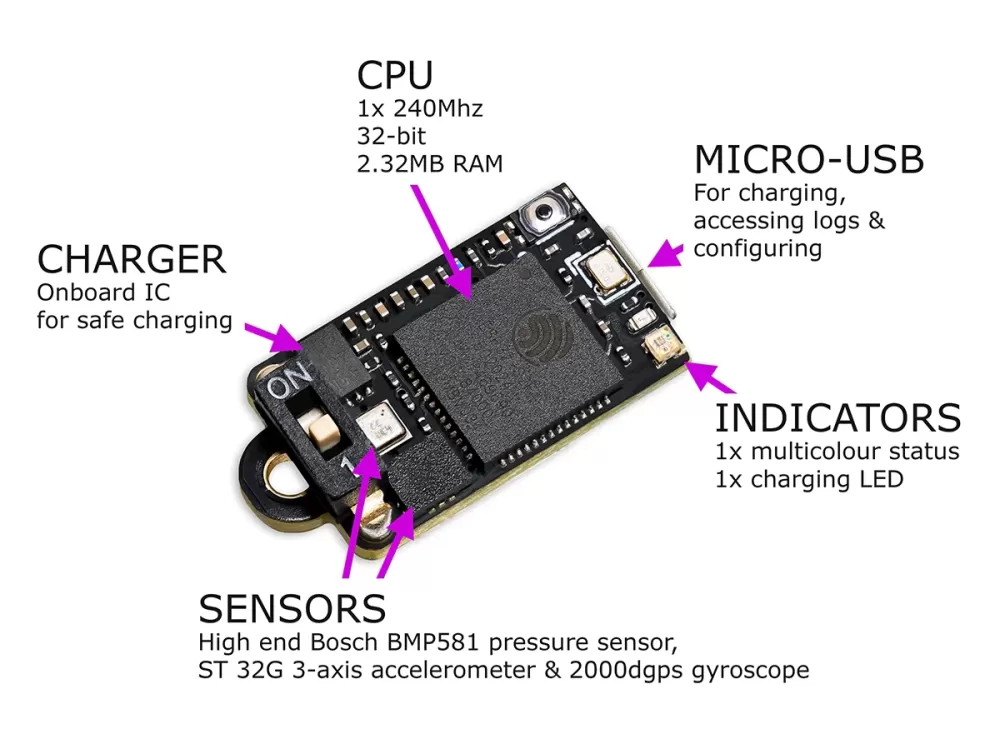
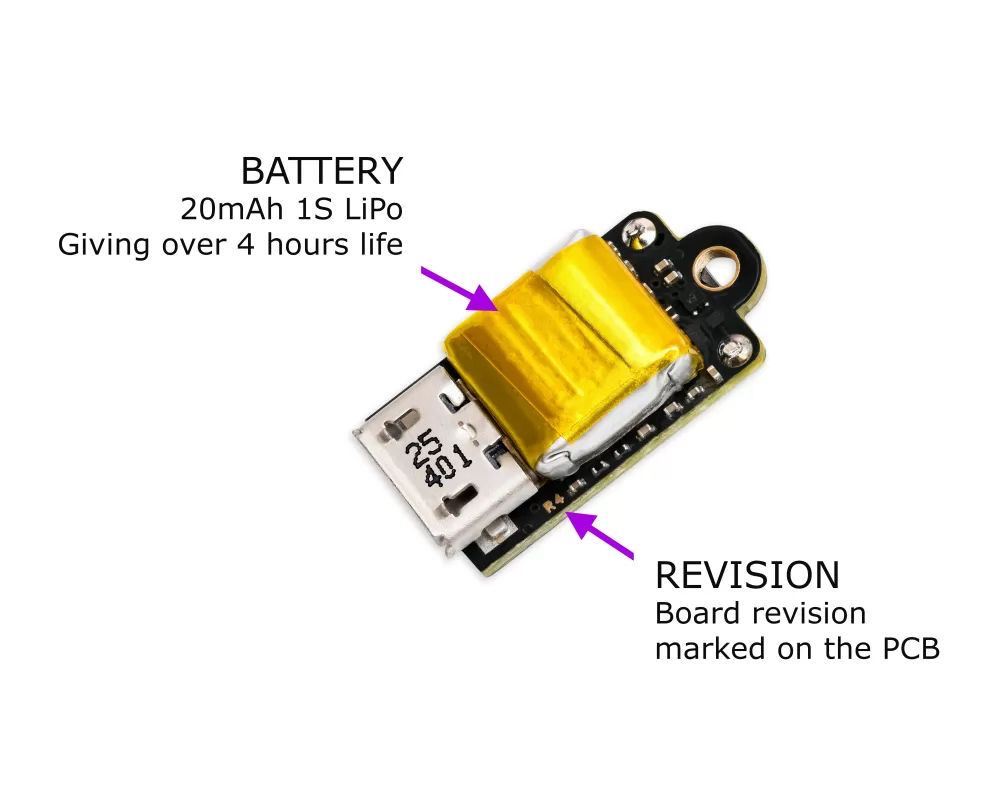
Top and underside of a Revision 4 board. The revision is printed on the PCB.
Data and charts
The onboard USB port means there's no hunting for that missing custom cable or reader. Just plug it into your PC, laptop or smartphone with a standard micro-USB cable and access your flight logs, settings file and summaries.
Uploading to the Altimeter Cloud website is just as simple: drag and drop the log file onto the upload page, or click USB upload and pick the flights straight off the Nano. Once there, the logs are verified as genuine and you can keep track of unlimited flight logs, as well as view the data in all its fine detail.
Here are some example Nano charts
Every flight also saves a flight info page beside its log. It opens in any browser and shows the apogee, speeds and a summary of the flight, so you can check a result without uploading at all.
Advanced filtering and fusion
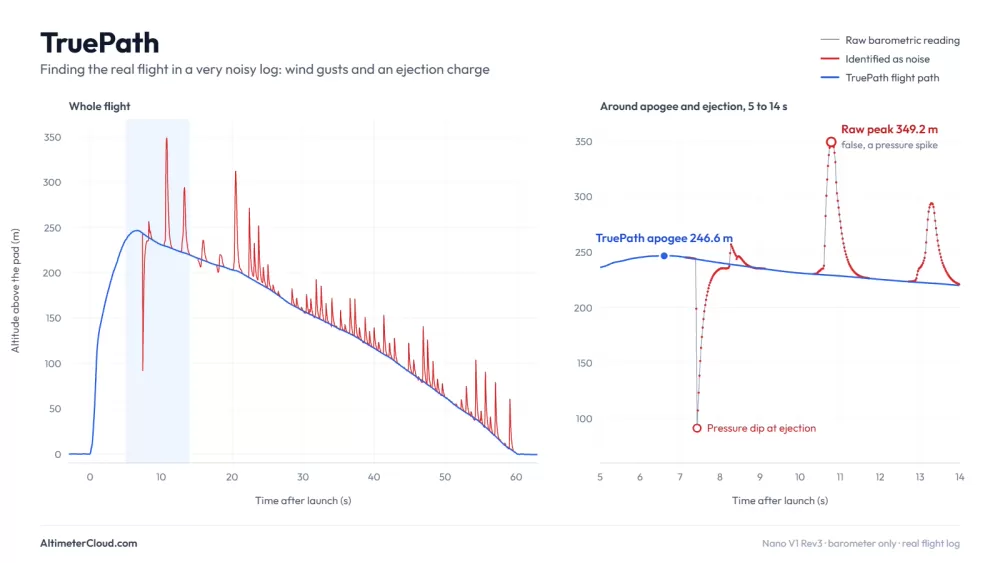
An old Revision 3 flight with far more wind noise than current sensors give, plus an ejection charge. It's a harder test for the filter, which is why I like it as an example.
Our TrueFuse and TruePath processing makes sure the altimeter's pressure-based data is accurate. TrueFuse uses the motion sensor to repair the launch and ejection, where pressure readings cannot be trusted, and TruePath removes spurious pressure spikes and smooths the trace. Both run on the Nano itself when the flight is saved.
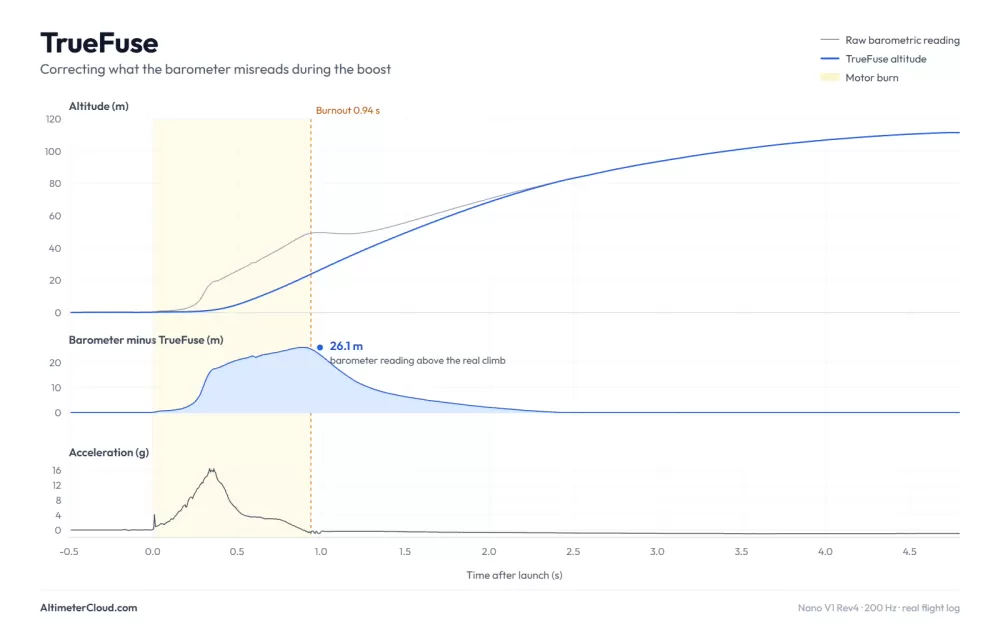
A Revision 4 boost where the barometer reads up to 26 m high. TrueFuse uses the motion sensor to follow the real climb.
Flight angles
The gyro tracks the rocket's attitude through the flight from a zero it calibrates on the pad. Roll, pitch and yaw are logged, as well as a tilt-from-vertical angle and the rail angle just before launch. You will need to mount your Nano in a fixed position to use the angle data effectively, of course.
Results on the field
You don't need a computer to read your altitude. When you switch the Nano on, or press the button on the pad, the LED blinks the last flight number and then its apogee, one colour per digit.
On Revision 4 boards the Nano goes to sleep after saving a flight but keeps watch. Give it a firm shake for a second or two and it blinks the result again, then goes back to sleep.
Reading the result after landing →
Crash recovery
While it's recording, the Nano keeps a backup copy of the flight in reserved memory. If the power is lost before the flight is saved, the next time it's switched on it rebuilds the flight from that copy, saves it and shows you the result. The recovered log is marked as such in its header, and it's signed just like any other flight, so it can still be proved genuine on Altimeter Cloud.
How the Nano has evolved
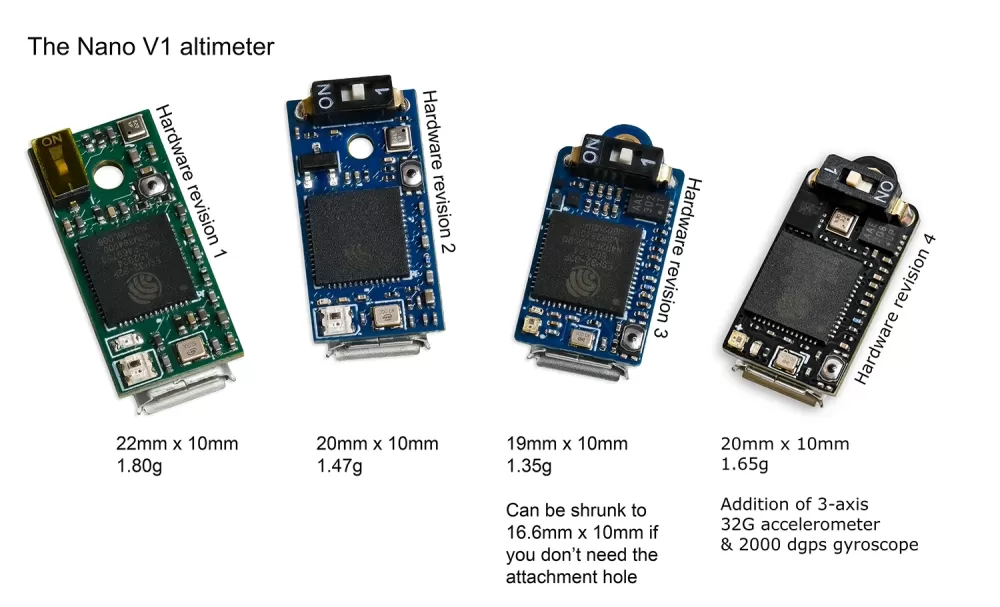
We've been learning a lot as we develop the Nano, and we somehow manage to keep squeezing more and more parts onto it without it needing to get any larger.
| Rev1 to Rev3 | Rev4 and later | |
|---|---|---|
| Pressure sensor | Bosch BMP390 | Bosch BMP581 |
| Motion sensor | None | ±32 g accelerometer, ±2000 dps gyro |
| Logging rates | 50 or 100 Hz | 104, 208, 417 or 833 Hz |
| Default rate | 50 Hz | 417 Hz |
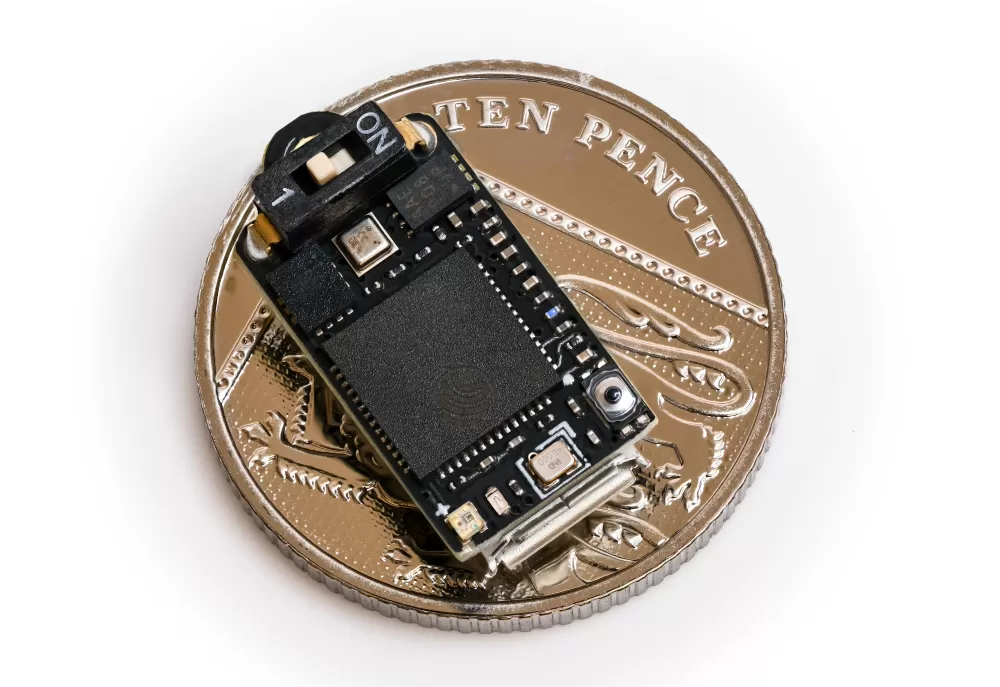
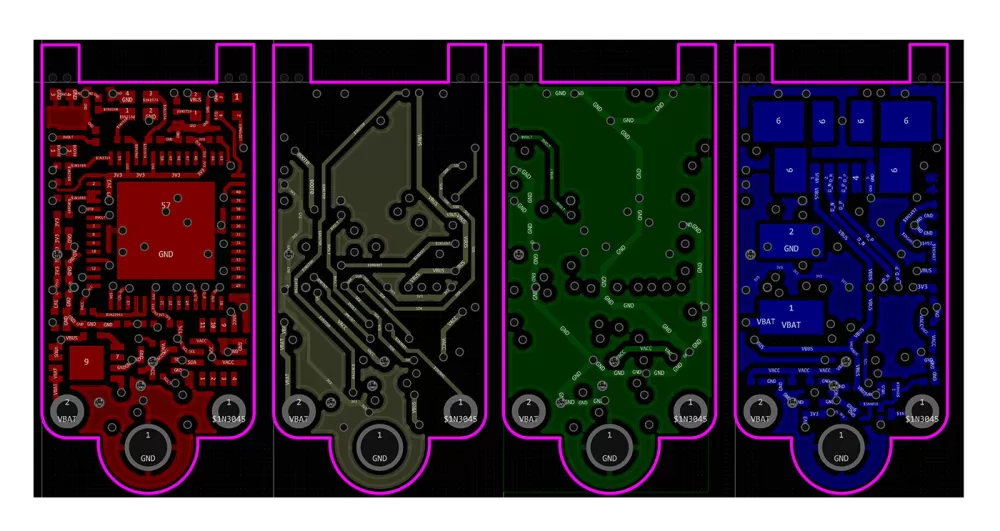
The four layers of the PCB, and the finished board on a 10p coin.
The Nano is manufactured from a high-quality four-layer PCB. With some of the components no bigger than a grain of sand, it's made by state-of-the-art, computer-controlled machines. It keeps up to 39 flight logs and works as a USB drive when you connect it to a PC, laptop or smartphone.
Don't let its tiny size fool you! This altimeter really is a high-quality piece of equipment. Why not join our project and try one out for yourself?