The Nano V1 is a tiny, lightweight barometric altimeter and flight data logger. Below are the specifications across hardware revisions. Revision 4 and later boards add an inertial measurement unit (IMU) and an upgraded pressure sensor.
The hardware revision is printed on the PCB (for example R4), and the Nano detects it itself at power-on, so one firmware runs on every revision. You can also check it over the USB connection.
You can find a 3D model of the PCB and the electronics bay holding cover files on the Technical & compliance page.
Physical
| Rev 1 to Rev 3 | Rev 4 and later | |
|---|---|---|
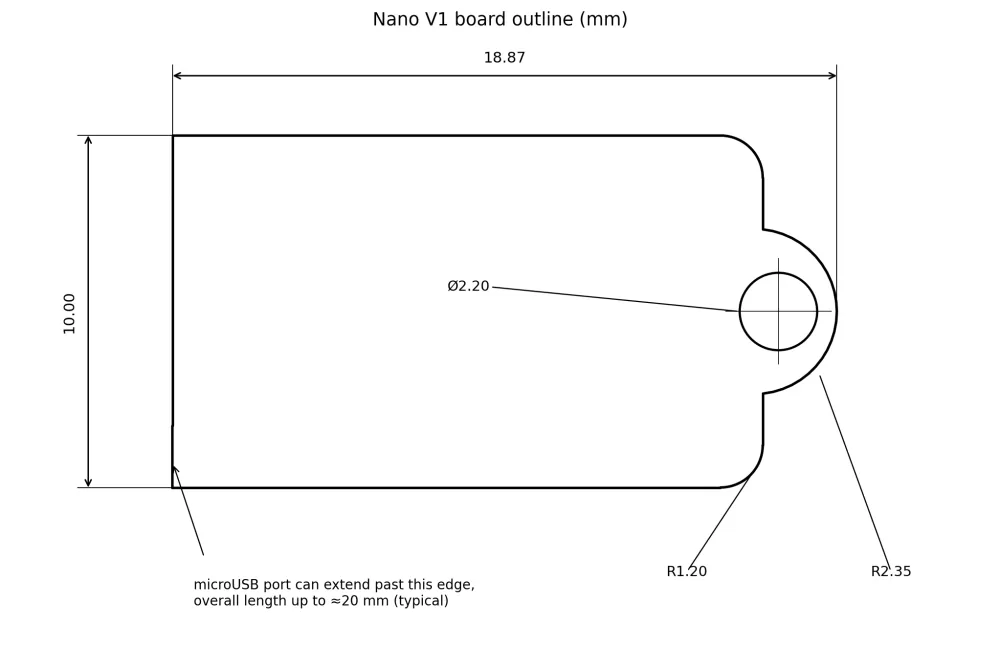
| Dimensions (PCB) | 19 to 22 × 10 mm, by revision | 20 × 10 × 8.9 mm |
| Weight | 1.35 to 1.80 g, by revision | 1.65 g |
| Connector | Micro-USB | |
| Bay cover | SLS printed nylon cover supplied, screws onto an electronics bay sled | |
| Mounting | Under its cover in an electronics bay, or on the shock cord | |
| Min tube diameter | 10 mm (without the cover) | |
Pressure sensor and altitude
| Rev 1 to Rev 3 | Rev 4 and later | |
|---|---|---|
| Pressure sensor | Bosch BMP390 | Bosch BMP581 |
| Pressure range | 300 to 1250 hPa | |
| Max reliable altitude | About 9,200 m (30,000 ft) | |
| Altitude conversion | Standard atmosphere, fixed at 1013.25 hPa and 15 °C. The reported apogee is barometric, above the pad. | |
| Logging rates | 50 or 100 Hz (default 50) | 104, 208, 417 or 833 Hz (default 417) |
| Barometer rate | Its own rate | 80 Hz, whatever the logging rate |
| Filtering | TruePath | TrueFuse and TruePath |
Accelerometer and gyroscope (IMU)
| Rev 1 to Rev 3 | Rev 4 and later | |
|---|---|---|
| IMU | Not fitted | ST LSM6DSO32 |
| Accelerometer | Not fitted | 3-axis, ±32 g |
| Gyroscope | Not fitted | 3-axis, ±2,000 °/s |
| Orientation outputs | Not available | Tilt, pitch, roll and yaw, plus launch rail angle |
| High speed sensor | Not available | On by default. The IMU samples at 1,667 Hz, or with the gyro at up to 3,333 Hz (setting 2), and the readings are averaged down to your logging rate. This counters motor and airframe vibration affecting the IMU readings, so the logged acceleration, rotation rates and angles are cleaner. It costs a percent or two of battery life. |
| Mounting orientation | Not applicable | Detected automatically on the pad, or set manually |
Data logging
| Rev 1 to Rev 3 | Rev 4 and later | |
|---|---|---|
| Logged data | Time, altitude and velocity, with the raw barometric altitude kept beside the processed line | Adds acceleration, rotation rates and angles |
| Flight events detected | Launch, apogee, ejection and landing | Adds motor burnout (each stage) and rail angle |
| Pre-launch data | 5 s at full rate plus 3 s at 50 Hz before launch is confirmed | |
| Hybrid mode | Off by default | On by default: full rate through launch, the climb, apogee, landing and any big shock, and 1 in 8 samples on the long descent |
| Max samples per flight | Up to 38,000 (ACLZ) or 22,000 (CSV) | |
| Recording time at full rate | About 12 minutes at 50 Hz, 6 at 100 Hz | About 6 minutes at 104 Hz, 90 s at 417 Hz, 45 s at 833 Hz. Hybrid mode extends these considerably. |
| Hybrid mode example | A 5 km flight with a 20 s climb, logged at 417 Hz with 1 in 8 hybrid mode, records for about 8.5 minutes, compared with 90 s without it. The climb, apogee, deployment and the last 20 m to landing are all logged at the full 417 Hz, and only the long descent drops to about 52 Hz. For a long, slow descent from that height, 208 Hz gives about 20 minutes, enough to log the whole flight and the landing. | |
| Recording stop | Automatic, 8 or 16 s after a settled landing, or at the sample limit | |
| Flights stored | Up to 39 (subject to space). The oldest is removed automatically, and flight numbers keep counting. | |
| Flight log format | ACLZ compressed binary (default) or CSV, on the onboard USB drive, with a flight info page for each flight | |
| Log integrity | Ed25519 digital signature, verified on Altimeter Cloud | |
| Crash recovery | A backup copy is kept during the flight and rebuilt at the next power-on if power is lost before the save | |
Power and battery
| Battery | 1S LiPo, 20 mAh (8 × 8 × 5 mm), soldered to the board |
| Battery life | Just under 5 hours on the pad. 5 to 8 typical flights per charge at 417 Hz. |
| Charging | Micro-USB (from a phone, laptop, etc.) |
| Charge controller | MCP73831, about 20 mA, 4.2 V termination |
| Charge time | Under 1 hour from empty |
| Charge indicator | Charge LED (on while charging, off when complete) |
| Low battery | Warning at startup below 3.70 V. In flight, recording stops and the flight is saved at 3.05 V. Shuts down at 2.92 V. |
| Operating temperature | Flight mode: -10 °C to 60 °C. USB mode and charging: 0 °C to 45 °C. |
| Over-temperature shutdown | On USB or while charging only. Never in flight mode. |
Connectivity and interface
| USB | Micro-USB: charging, serial, configuration and a USB drive for the logs and settings |
| WiFi | Not available: no antenna is fitted and WiFi is permanently disabled in the encrypted firmware |
| Readout | LED blinks the last flight number and apogee at power-on or on a button press. On Rev 4 and later, a shake after landing does the same. |
| Cloud and charts | Drag and drop log files onto Altimeter Cloud, or use USB upload on the website (account optional) |
Processor and memory
| Microcontroller | Espressif ESP32-S2, 240 MHz, 32-bit |
| Flash | 4 MB |
| PSRAM | 2 MB |
Firmware and security
| Firmware | AES-256 encrypted (custom firmware cannot be loaded) |
| Flight log verification | Ed25519 digital signature (tamper-evident), recovered logs included |
| Firmware updates | Via Altimeter Cloud over USB |
| Configuration | Settings file on the USB drive, or over USB serial |
Specifications are subject to change with firmware updates and describe firmware 2.00. Some features require the latest firmware version. If you are unsure which revision you have, please contact us.